 WhatsApp 079 885 8806
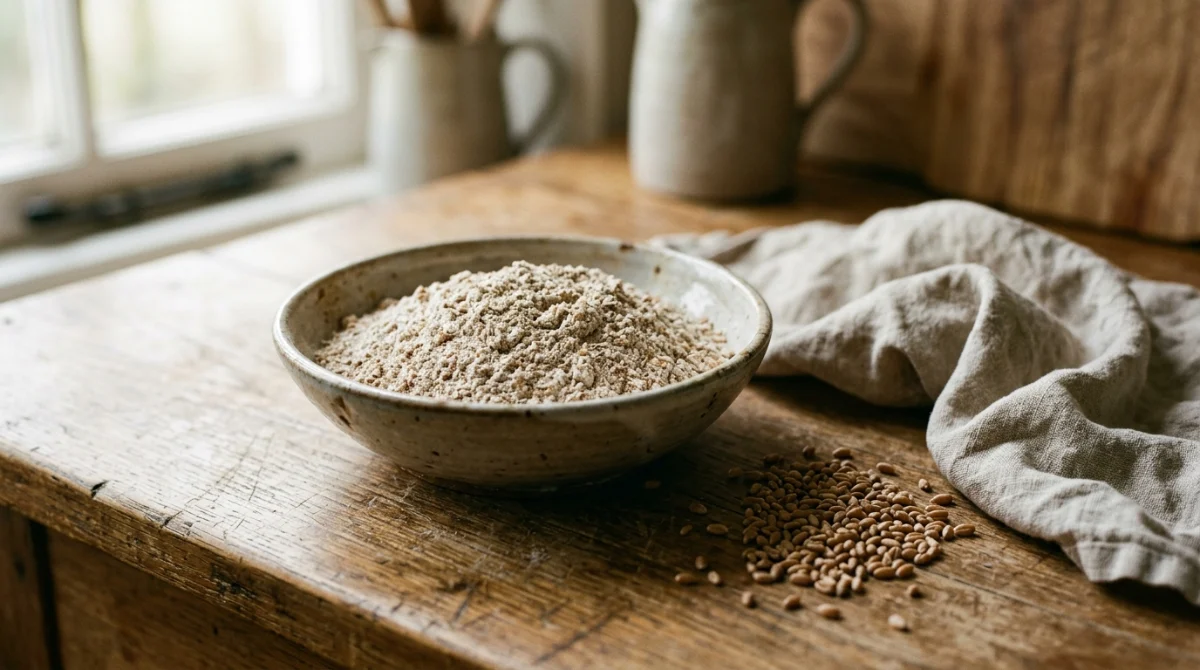
There are only three grain mill types in a domestic kitchen, and they are separated by what they physically do to the grain: one grinds it between two stones, one shatters it against spinning steel, and one crushes it between metal burrs. Everything else (the wood, the hopper, the branding) is a box around one of those three mechanisms. Choose the mechanism first. Stone mills give the widest useful range and the best bread flour in a single pass. Impact mills go finer and faster but only make fine flour, and they are very loud. Steel burr mills are the most tolerant of difficult material and the cheapest to buy, but they will not make bread flour in one pass.
If you are new to all of this, start with our overview of stone grain mills and fresh flour at home. Here is the whole decision in one table, and then the reasoning behind it.
On this page
- The three grain mill types at a glance
- What is actually happening inside each type of mill?
- Which type makes the finest flour?
- Which type runs coolest, and does flour temperature actually matter?
- Can I grind oily seeds, coffee or spices?
- How loud is each type, really?
- Which grain mill type lasts longest, and what wears out?
- Which type should you buy for home baking in South Africa?
- What does each type cost in South Africa?
- Frequently asked questions
- The stone mills we stock
The three grain mill types at a glance
| Stone | Impact | Steel burr | |
|---|---|---|---|
| How it works | Grain is sheared and abraded between a fixed and a rotating stone | Grain is shattered against rows of steel fins spinning at high speed | Grain is crushed and sheared between two metal plates or cones |
| Typical fineness, one pass | ~150–250 microns — true bread flour | ~50–120 microns — finer than most shop flour | ~400–700 microns — coarse meal |
| Coarse settings (cracked grain, samp, mieliemeal) | Yes, full range | No — fine only | Yes, excellent |
| Oily seeds (flax, sesame, sunflower, nuts) | No | No | Tolerates small amounts |
| Damp or sprouted grain | No | No | Some models, with care |
| Washable | Never | No | Usually yes |
| Noise at 1 m, typical | 78–88 dB | 95–105 dB | 75–85 dB |
| Wear part | The stones | The impact chamber | The burrs |
| Wear part lifespan | Decades of domestic use | Replaceable component | Sharpen or replace |
| Indicative SA price, Oct 2026 | R9,000 – R25,000 | R8,000 – R15,000 (seldom stocked locally) | R1,200 – R6,000 |
Fineness and noise figures above are typical measured ranges for domestic machines, not manufacturer specifications. Treat them as the right order of magnitude rather than a spec sheet.
What is actually happening inside each type of mill?
Stone mills
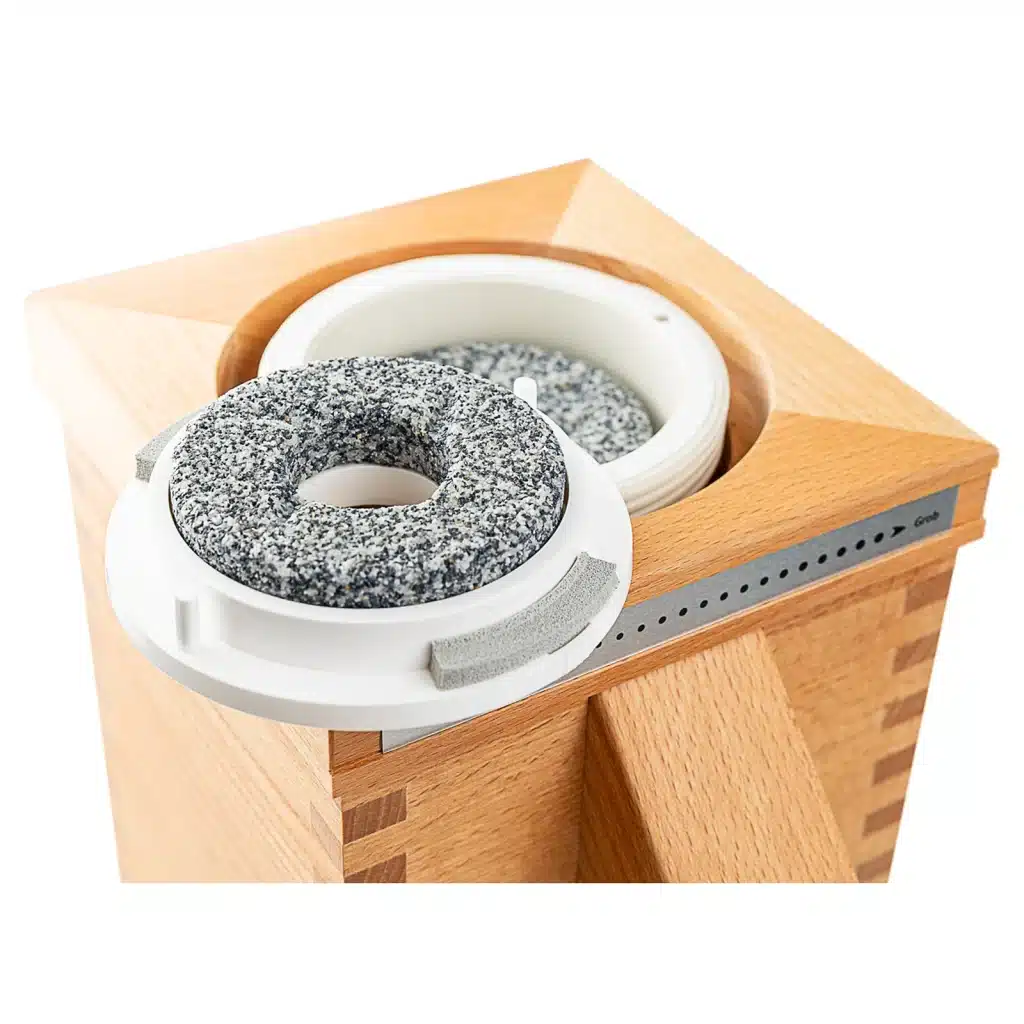
Two discs, one fixed and one driven. Grain is fed into the centre, travels outward through a narrowing gap, and is progressively sheared smaller until it exits at the rim as flour. Fineness is set by moving the stones closer together or further apart, usually on a continuous dial rather than in steps.
The important detail is that a stone mill grinds the whole berry together and keeps it together. Bran, germ and endosperm are all reduced in the same pass and arrive at the outlet mixed. That is exactly what you want for whole grain baking, and it is why one pass is enough.
Domestic stone mills use one of two materials. Natural stone, such as granite or quartz composite, sits around 6 to 7 on the Mohs hardness scale. Ceramic-corundum, which is sintered aluminium oxide, sits at 9, one step below diamond. The harder material wears more slowly, holds its cutting profile longer, and does not shed grit into the flour. Sana’s mills use 85 mm ceramic-corundum stones for that reason.
Both types self-sharpen. As the surface wears, fresh abrasive edges are exposed. A stone mill that gets a few kilograms a week through it is a decades-long proposition, not a consumable.
Impact mills
No grinding surfaces at all. A rotor carrying rows of steel fins spins inside a chamber with matching stationary rows. Grain enters the centre, gets flung outward, and is hit repeatedly until the fragments are small enough to escape between the rows. The industry name is a microniser, and that tells you the intent: very small particles.
There is no fineness adjustment in the stone-mill sense, because fineness is a function of how small a particle has to be to get out of the chamber. You can sometimes vary it by changing feed rate or rotor speed, but you cannot ask an impact mill for cracked wheat. It makes one thing: very fine flour.
Steel burr mills
Two metal burrs, either flat plates or nested cones, with cut teeth that get finer toward the outside. Grain is drawn in by the teeth and crushed and sheared as it travels. Mechanically this is the oldest and simplest design, and it is what almost every hand-cranked mill uses.
Burr geometry is a compromise. The teeth needed to pull grain in and crack it are too coarse to produce flour-fine particles. Push a burr mill to its finest setting and you get a fine meal, not flour, and you generate a lot of heat doing it, because at that gap the burrs are in near-contact and most of the motor’s work goes into friction rather than cutting.
Which type makes the finest flour?
Impact, then stone, then steel burr. For home baking, though, that order is misleading.
Impact mills produce the finest flour available domestically, often finer than commercial roller-milled cake flour. That is a genuine advantage for cakes, pastry and anything where you want no perceptible grit. It is a disadvantage for bread, because very fine bran particles are more damaging to the gluten network than slightly coarser ones. The bran in fresh-milled flour behaves like microscopic blades cutting the gluten strands as they form; shattering it finer gives you more cutting edges, not fewer.
Stone-milled flour at a fine setting is in the right range for bread: fine enough to hydrate properly, coarse enough that the bran is in flakes rather than shards. If you want finer than that, you sift. A fine sieve takes out the coarsest bran for a high-extraction flour, and a coarser one takes out enough to get close to white.
A steel burr mill cannot make bread flour in one pass. Two passes, coarse then fine, will get you there. That is a legitimate workflow, but it is two passes every time.
Getting a stone mill to its actual finest setting
Run the mill empty and turn the adjustment finer until you just hear the stones touch: a faint dry whisper, not a scrape. Then back off one notch. That is your finest safe setting, and it is usually finer than the marked “fine” position. Do this on a new mill and again after a year, because the stones wear and the setting drifts.
Which type runs coolest, and does flour temperature actually matter?
It matters less than the internet suggests, and more than nothing.
The concern is that heat damages the germ oils and the heat-sensitive vitamins in fresh flour. The thresholds that matter are well above what a domestic mill produces in normal use. Below about 50 °C you are fine. Above roughly 60 °C, sustained, you start getting measurable changes. A domestic stone mill at a fine setting typically delivers flour somewhere between ambient and 15 °C above ambient. On a 30 °C Highveld afternoon you might see flour at 40–45 °C; on a Cape winter morning you will not get near it.
One surprise: impact mills can run cooler per kilogram than stone mills, because each grain spends milliseconds in the chamber rather than travelling through a grinding gap. The chamber air gets hot, but the flour does not spend long in it. Steel burrs at a fine setting are the worst of the three, because that is where contact friction is highest.
How to actually check instead of worrying: mill 500 g, stick an instant-read probe straight into the middle of the pile at the outlet, and read it. If you are under 45 °C you have nothing to think about. If you are over, mill in two passes, coarse first and then fine, and let the flour cool in between. Two-pass milling is the standard fix for heat, and it is the reason experienced millers use it for hard grains like khorasan.
Also worth knowing: a cold hopper helps. Grain stored in a cool pantry mills cooler than grain that has been sitting in a sunny kitchen.
Can I grind oily seeds, coffee or spices?
| Material | Stone | Impact | Steel burr |
|---|---|---|---|
| Wheat, spelt, rye, einkorn, emmer, khorasan | Yes | Yes | Coarse only, one pass |
| Maize (dry), sorghum, millet | Yes | Yes | Yes |
| Rice, buckwheat, quinoa, amaranth | Yes | Yes | Yes |
| Dried legumes — chickpeas, lentils, beans | Yes, small batches | Yes | Yes |
| Flax, sesame, sunflower, hemp, poppy | No | No | Small amounts only |
| Nuts, nut butters, coconut | No | No | No |
| Coffee | No | No | Only on a mill made for it |
| Fresh herbs, anything damp, sprouted grain | No | No | Some, with care |
| Hard spices — black pepper, coriander seed, dried chilli | Small amounts, accept the carry-over | Small amounts | Yes |
The rule behind the table is simple: oil and moisture are what kill mills, not hardness. Stone and impact mills cannot be washed. Oil from seeds or nuts soaks into a porous stone or coats an impact chamber, goes rancid, and taints everything you mill afterwards, and you cannot get it out. Steel burrs can usually be dismantled and washed, which is why they are the only one of the three with any tolerance for oily material.
The dryness test for anything you are unsure about: bite a grain or seed. If it splinters, it is dry enough to mill. If it squashes or dents, it is not.
Never put water near a stone mill. If the stones are clogged or stuck, run a handful of coarse rice through on a medium setting, or use a dry brush. Water in a porous stone is a mill-ending mistake.
How loud is each type, really?
Loud enough that you should plan for it. Brochures rarely give a figure, so here are typical ones.
A domestic stone mill at 1 m sits around 78–88 dB, comparable to a food processor or a vacuum cleaner, and it stays in that range for as long as you are milling. An impact mill is typically 95–105 dB, which is a different category of experience. Decibels are logarithmic: every 10 dB is roughly a doubling in perceived loudness, so a 100 dB impact mill is not “a bit louder” than an 85 dB stone mill. It is around three times as loud.
Practical consequences. Milling 2 kg takes roughly 20 minutes on a 100 g/min machine. That is 20 minutes of sustained noise, so it is not something you do at 5 a.m. in a flat with thin walls. You will also want hearing protection for an impact mill and a conversation with whoever else is in the house. A stone mill on a wooden counter transmits less than one on tiles or stone; a silicone mat under the feet makes an audible difference.
And the dust. All three types put fine flour dust into the air, impact mills most of all. Mill into a tall container rather than a wide bowl, let it settle for a minute before you lift the lid, and if you are milling regularly, expect a fine film on nearby surfaces.
Which grain mill type lasts longest, and what wears out?
| What wears | Typical domestic life | Serviceable? | |
|---|---|---|---|
| Stone | Stone faces wear flatter and slightly larger in gap | Decades at a few kg/week; stones replaceable | Yes, stones are a replaceable part |
| Impact | Fins and chamber walls erode | Chamber replaced periodically | Yes, as a unit |
| Steel burr | Teeth dull, especially the fine outer teeth | Years; faster if run at finest setting | Sharpen or replace burrs |
The motor is the other half of the question and the part people underestimate. A mill that is working at its limit every bake will not last like one with headroom. This is the real argument for a larger motor: not speed, but duty cycle. A 360 W machine milling 100 g/min is fine for a loaf or two. If you bake for a family every week, or mill 3–5 kg at a sitting, a 600 W machine at 200 g/min finishes in half the time and spends that time working well inside its envelope.
The number that actually tells you a manufacturer’s own view of longevity is the warranty. Sana’s mills carry a 12-year warranty, which is a long way outside normal appliance practice and a reasonable proxy for expected life.
Which type should you buy for home baking in South Africa?
Buy a stone mill if you are baking bread, you want one machine that does everything from cracked wheat to pastry flour, and you want it in one pass. This covers the overwhelming majority of home millers. The range matters more than any single capability: on a Saturday you might want coarse samp for a stew, medium mieliemeal for pap, and fine flour for a sandwich loaf, and only a stone mill gives you all three on one dial.
Buy an impact mill if your baking is overwhelmingly cakes, biscuits and pastry, you specifically want flour finer than shop cake flour, and noise really doesn’t matter in your house. They are also seldom stocked in South Africa, so expect to import and to have no local spares path.
Buy a steel burr mill if your budget is under about R4,000, you want a hand mill as a load-shedding backstop, you mostly want cracked grain and coarse meal, or you need something you can wash. A hand burr mill alongside an electric stone mill is a sensible combination and a lot of South African households end up there.
The local-support question is not a tiebreaker, it is often the deciding factor. A mill is a 20-year appliance with wear parts. Before you buy, ask three things: who holds stock of the stones or burrs for this machine in South Africa, who repairs it, and what happens to the warranty if the importer stops carrying the brand. A cheaper mill with no local spares path is more expensive the first time something wears out.
What does each type cost in South Africa?
Indicative ranges as at October 2026, for the mechanism rather than any particular machine:
| Type | Entry | Mid | Upper |
|---|---|---|---|
| Hand steel burr | R1,200 | R2,000 | R3,500 |
| Electric steel burr | R2,500 | R4,000 | R6,000 |
| Electric stone | R9,000 | R13,000 | R25,000 |
| Impact / micronising | R8,000 | R11,000 | R15,000 |
The payback depends entirely on what you are replacing, and the two answers are very far apart. Most write-ups quote only the flattering one.
A standard loaf uses about 500 g of flour, so two loaves a week is roughly 52 kg of flour a year. Our guide to how much grain you need has the full conversion tables.
If you currently buy bread. A wholemeal loaf from a decent bakery is R55–R90. The grain in a home-milled equivalent, at R25–R45/kg, is R12.50–R22.50. Call the saving R40 a loaf, and 104 loaves a year puts you about R4,100 ahead. A R10,999 mill is paid off in roughly two and a half years, and after that you are about R4,100 a year ahead.
If you already bake your own bread from bagged flour, the picture changes completely. Now you are only saving the difference between whole berries and bagged flour, perhaps R10–R25/kg against bagged stoneground wholewheat. Over 52 kg a year that is R500–R1,300, and the payback stretches to eight or even twenty years. At household volumes, on that comparison, a mill does not pay for itself in any meaningful sense.
Three things move the second case back toward sensible: baking heavily, at five or more loaves a week and 130 kg of flour a year; currently buying premium organic or specialty flour at R80–R150/kg, where the per-kilogram saving is four or five times larger; or milling einkorn, emmer and khorasan, which are either unobtainable as flour in South Africa or priced as a delicacy when you can find them.
So if you are already a home baker, buy a mill for the flour rather than the savings, and the flour is a good reason on its own. Whole-grain flour tastes best within a week or two of milling, and shop flour has usually been on the move for longer than that before it reaches you. Fresh-milled flour is the one version you can’t buy. The money, on that comparison, is roughly a wash.
We will take all of this apart properly, with current South African grain prices and the electricity and time included, in a dedicated piece on whether milling your own flour is worth it.
Frequently asked questions
Is a stone mill or an impact mill better for bread?
Stone. Stone-milled flour at a fine setting lands in the right particle range for bread, with the bran in flakes rather than shards. Impact mills shatter bran finer, which gives you more cutting edges against the gluten network and a tighter crumb. Impact mills are better for cake and pastry flour.
Will a steel burr mill make bread flour?
Not in one pass. Expect a fine meal at the finest setting. Two passes, coarse then fine, will get you to usable bread flour, but you are doing it every bake, and the second pass at a tight gap generates a lot of heat.
Does milling flour destroy the nutrients through heat?
Not at domestic temperatures. Problems start above roughly 60 °C sustained, and a home stone mill typically delivers flour between ambient and about 15 °C above ambient. Check with an instant-read probe at the outlet; if you are under 45 °C there is nothing to manage. If you are over, mill in two passes and let the flour cool between them.
Can I grind flax, sesame or nuts in a stone mill?
No. Oil soaks into the stones, goes rancid and taints every later batch, and stones cannot be washed. Use a dedicated spice or seed grinder for oily material. Steel burr mills tolerate small amounts because they can be dismantled and cleaned.
How do I clean a stone mill?
Dry only. Run a handful of coarse rice through on a medium setting to clear residue, then brush out the chamber with a dry brush. Never use water: a porous stone that has absorbed water is usually finished.
How loud is a home grain mill?
A stone mill runs around 78–88 dB at a metre, similar to a vacuum cleaner, for as long as you are milling. Impact mills are typically 95–105 dB, which is roughly three times as loud to the ear and warrants hearing protection. Milling 2 kg on a 100 g/min machine takes about 20 minutes of continuous noise.
Do grain mill stones need replacing or sharpening?
Neither, in normal domestic use. Stone mills self-sharpen as they wear, exposing fresh abrasive surface. Ceramic-corundum stones sit at 9 on the Mohs scale and wear very slowly. They are a replaceable part if you ever need it, which is a good reason to buy a brand with a local spares path.
What size motor does a home grain mill need?
A 360 W machine at around 100 g/min suits a household milling under 2 kg at a time. If you mill 3–5 kg at a sitting or bake weekly for a family, a 600 W machine at around 200 g/min halves the time and runs further inside its comfortable range, which matters more for longevity than for speed.
Can I mill wet or sprouted grain?
Not in a stone or impact mill, because moisture will clog and damage both. Some steel burr mills will handle lightly damp grain. The test: bite a grain. If it splinters it is dry enough; if it dents, dry it further first.
Which mill type is best for maize and mieliemeal?
Stone or steel burr, because both do coarse settings. A stone mill will take you from coarse samp through medium mieliemeal to fine maize flour on one dial. An impact mill only makes fine flour and cannot produce a coarse grind at all.
The stone mills we stock
EcoHub is the official South African importer of Sana grain mills, which are stone mills using 85 mm ceramic-corundum stones in a solid beechwood housing, made in Austria and carrying a 12-year warranty.
| Sana Grain Mill 360W | Sana Grain Mill MAX 600W | |
|---|---|---|
| Milling rate | 100 g/min | 200 g/min |
| Hopper | 850 g | 1,200 g |
| Stones | 85 mm ceramic-corundum | 85 mm ceramic-corundum |
| Warranty | 12 years | 12 years |
| Price | R10,999 | R15,999 (was R18,999) |
| View the 360W → | View the MAX 600W → |
Imported, warranted, stocked and supported locally, with spares and service in South Africa, from a business that has been trading since 2012. PayJustNow available.
Prices correct at October 2026.