 WhatsApp 079 885 8806
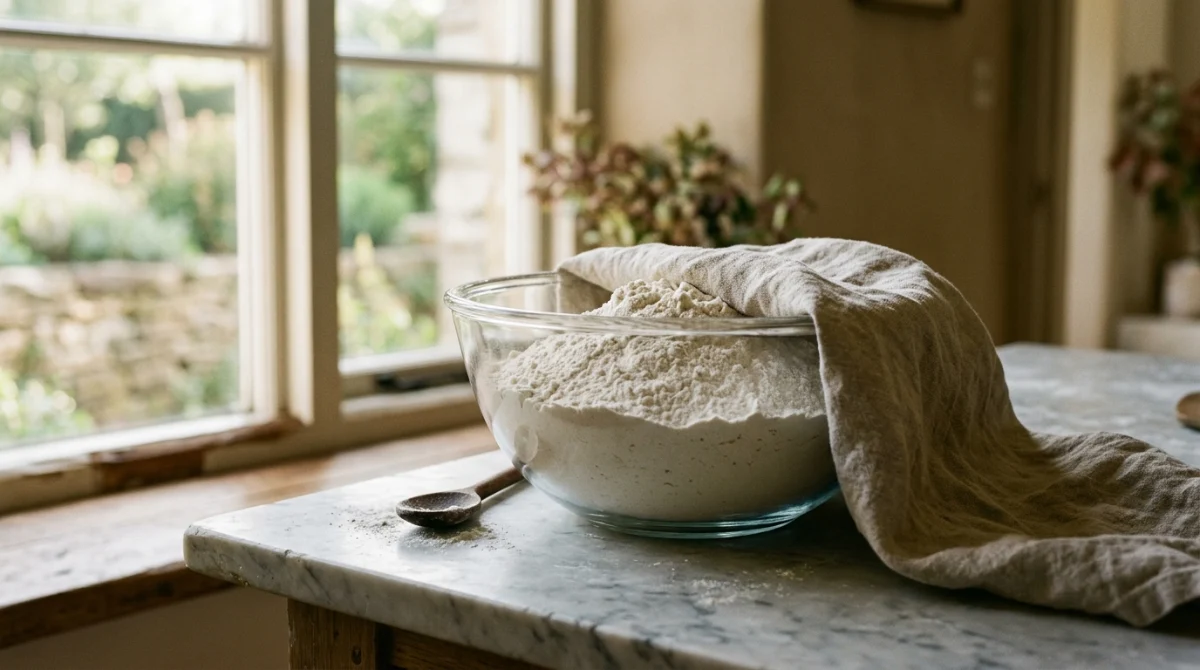
Short answer: if you mill whole-grain flour at home, no. Bake with it fresh, and freeze what you don’t use within a week or two. Resting (or “ageing”) flour does make dough stronger, but the effect was measured in white flour and it’s modest: about a 7% bigger loaf after 10 days in the best-known study. In whole-grain flour, the same weeks give the oils in the germ time to break down and turn bitter. The one case where resting pays is flour you’ve sifted into high-extraction or near-white flour. There, one to three weeks in a sealed tub is worth trying.
That’s the answer. The rest of this article is why, because this is one of the most argued-about questions in home milling and the arguments on both sides are usually half right.
On this page
- What actually happens when flour “ages”?
- How much difference does resting make? The numbers
- What happens to whole-grain flour while it rests?
- Is there a “bad window” after milling? The 72-hour rule
- So should you rest fresh-milled flour? A decision table
- If not resting, what actually fixes slack fresh-milled dough?
- How should you store fresh-milled flour, then?
- Where the mill fits in
- Frequently asked questions
- Sources
What actually happens when flour “ages”?
Two separate things happen in a bag of flour after it leaves the mill, and they pull in opposite directions.
1. The gluten-weakening compounds oxidise away. Wheat contains glutathione, a small molecule that breaks the bonds (disulphide bonds) that link gluten proteins into a strong network. The germ is where most of it sits. In freshly milled flour, glutathione is active and dough tends to be slacker and stickier. Over the first week or two, exposure to air oxidises it, and dough made from that flour holds its shape better and rises higher. This is the real, measurable basis of the “rest your flour” advice.
2. The oils start breaking down. Whole grain carries the germ and the bran, and with them fat and the enzymes that attack fat: lipase, which splits oils into free fatty acids, and lipoxygenase, which oxidises them. Over 70% of the fatty acids in whole grain are unsaturated, which makes them easy to oxidise. The products of that breakdown are what you taste as stale, cardboard, or bitter.
White flour has had most of the germ and bran removed, so it gets the benefit of (1) with very little of the cost of (2). Whole-grain flour gets both. That single difference explains nearly all the contradictory advice out there.
How much difference does resting make? The numbers
The study most people are really quoting, whether they know it or not, is Chen and Schofield, published in Cereal Chemistry in 1996. They milled white flour from a bread wheat, stored it at 20 °C for up to 40 days and baked with it along the way.
| Measure | Freshly milled | After 10 days at 20 °C | After 40 days |
|---|---|---|---|
| Reduced glutathione (GSH) | 149 nmol/g | 85 nmol/g (−43%) | Stable from day 10 |
| Oxidised glutathione (GSSG) | 61 nmol/g | 17 nmol/g (−72%) | Stable from day 10 |
| Loaf volume | 1,250 ml | 1,338 ml (+7%) | 1,338 ml — no further gain |
Three things to take from that table:
- The gain is real but small. Seven per cent more volume is noticeable on a tin loaf. It is not the difference between a brick and a good loaf.
- It’s done in about 10 days. Everything that happened, happened early. Leaving flour for months bought nothing extra.
- It was white flour. We found no study showing the same curve for home-milled wholemeal, and there’s good reason to expect the gain to be smaller, because in whole-grain dough the bran does far more damage to gluten than glutathione does.
What happens to whole-grain flour while it rests?
This is the side of the argument the “age your flour” camp tends to skip.
- Bran is the reactive part. T. Galliard’s work in the Journal of Cereal Science (1986) found bran deteriorated at roughly five times the rate of germ over 30 days at 20 °C, and that finer milling sped up deterioration in every sample. Fine, fresh wholemeal is exactly the most reactive form.
- Free fatty acids build up over time. In a 2018 University of Nebraska study (Poudel and Rose, Food Chemistry), untreated whole wheat flour kept at room temperature for six months accumulated 8.8 µmol/g of free fatty acids. Flour that had been briefly steamed to knock out the enzymes built up only 2.2 µmol/g. Commercial “stabilised” wholemeal exists for exactly this reason.
- The oxidation happens fast once water arrives. Galliard also showed that once flour is wetted, lipoxygenase oxidises the freed fatty acids within minutes. So flour that has sat for weeks and built up free fatty acids hands the dough a load of raw material for off-flavours the moment you mix.
None of this makes three-week-old wholemeal dangerous. It makes it taste flatter and slightly bitter, which rather defeats the point of owning a mill. King Arthur’s guidance is one to three months for whole-grain flour at cool room temperature and up to six months frozen. In a Durban or Lowveld summer kitchen, where the cupboard sits at 28 °C, you should expect the short end of that.
Is there a “bad window” after milling? The 72-hour rule
You’ll often read that fresh flour is fine for a day or two, then goes through a weak patch, then recovers after a couple of weeks, so you should use it within 72 hours or wait. We’ve looked for research behind that dip-and-recover pattern and couldn’t find any. In Chen and Schofield’s data the freshly milled flour made the smallest loaf, and glutathione fell steadily over the first ten days rather than spiking. On that evidence, day-one flour is the weakest point, not a sweet spot.
The companion claim, that fresh flour “loses its nutrients within 72 hours”, is repeated everywhere and isn’t supported either. Oil breakdown and some vitamin losses are gradual, measured in weeks and months. If you want the evidence on what fresh milling does and doesn’t do for nutrition, we covered that in Is fresh-milled flour actually healthier?
What is true from experience: flour straight off the stones is warm, and warm flour gives you a warmer dough that ferments faster. Letting it cool to room temperature for half an hour is sensible. That isn’t ageing. It’s temperature management.
So should you rest fresh-milled flour? A decision table
| What you milled | Rest it? | What to do |
|---|---|---|
| 100% wholemeal wheat or spelt, for bread | No | Bake within a few days. Freeze the rest in an airtight tub. |
| Rye (any) | No | Rye bread relies on starch and pentosans, not gluten strength, so there’s nothing to gain. Use fresh. |
| Sifted high-extraction flour (#40 sieve, 5–7% bran removed) | Optional | A week in a sealed tub can firm up the dough slightly. Try one loaf fresh and one at day 7 and judge for yourself. |
| Sifted near-white flour (#30 sieve or finer, 15–20% removed, most germ gone) | Yes, if you want | 1–3 weeks at room temperature behaves most like the research. Past about 10 days there’s little extra gain. |
| Flour for pancakes, muffins, flatbreads, biscuits | No | These don’t depend on gluten strength. Fresh gives the best flavour. |
| Flour for pasta | No | Rest the dough for 30 minutes instead — it matters far more. |
If not resting, what actually fixes slack fresh-milled dough?
When people say their fresh flour “needs ageing”, they usually mean the dough is slack, sticky and spreads. Almost always, that’s a whole-grain handling problem, and these fix it faster than a fortnight on the shelf. Our 70/30 first-loaf recipe on SanaStore puts them together into a full method.
- Rest the dough, not the flour. An autolyse of 60 to 90 minutes (flour and water only, before salt and leaven) lets the bran soften and hydrate.
- Use more water, then wait. Fresh wholemeal wants roughly 85–90% hydration, against 70–80% for bought flour, and it firms up over 30 to 60 minutes. Adding flour in the first ten minutes is the classic mistake.
- Mix less. Long kneading lets the bran cut the gluten you’ve built.
- Ferment a little shorter. Fresh whole-grain dough moves faster than white, and the fridge slows it less than you’d expect.
- Sift out some bran. Removing even 5–7% of the coarsest bran with a #40 sieve makes a visible difference.
- The industrial shortcut: vitamin C. Bakeries use ascorbic acid as a dough oxidiser, because it does in minutes what ageing does in days. The dose is tiny. Commercial use goes up to 150 ppm on flour weight, which for a 500 g loaf is at most 75 mg; around 50 mg is plenty. That’s a fraction of a pinch, and a level ⅛ teaspoon is about ten times too much. Only worth it if you want a lofty sandwich loaf.
How should you store fresh-milled flour, then?
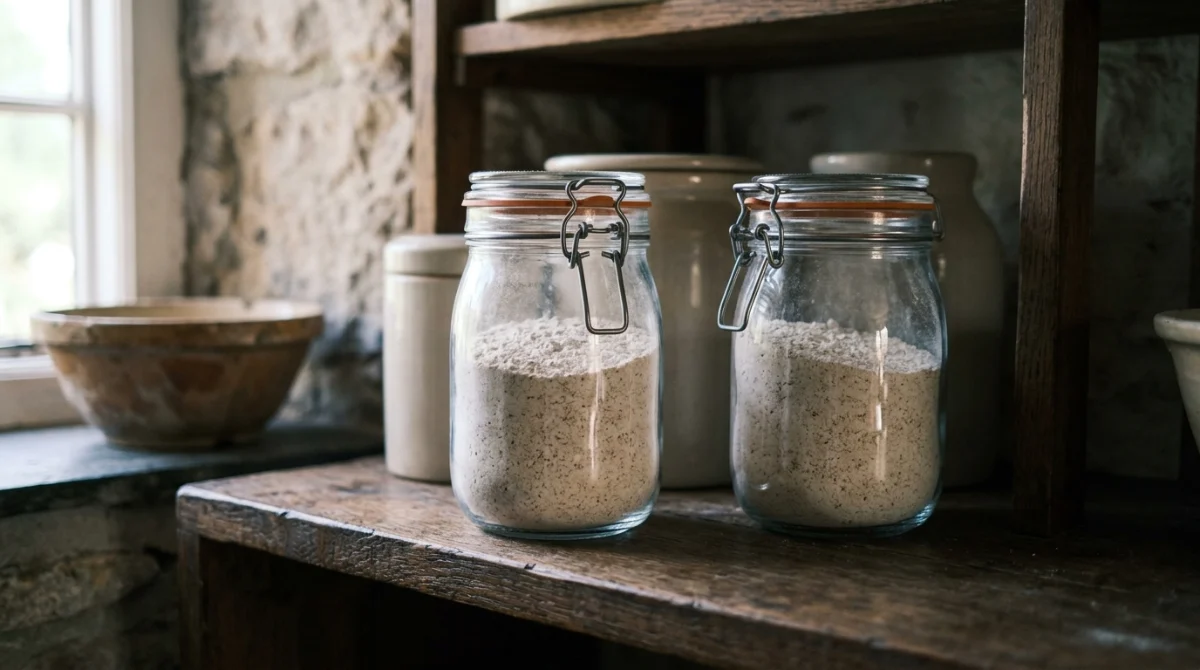
The best storage is not needing any: mill what you need for the week. That’s the whole advantage of having a mill on the counter. Whole grain keeps for years; flour keeps for weeks.
| Where | How long it stays good (whole-grain flour) | Notes |
|---|---|---|
| Counter, airtight jar | About a week for best flavour | Fine for day-to-day baking. Keep away from the kettle and the sunny windowsill. |
| Cool cupboard | 1–3 months (King Arthur guidance) | Shorter in a hot kitchen. Smell it: nutty is fine, crayon or paint is rancid. |
| Fridge | A few months | Works, but condensation is a risk every time you open a cold tub in a warm kitchen. |
| Freezer | Up to 6 months | The best option for anything past a week. Let the tub reach room temperature before opening. |
| Whole grain berries, sealed | Years | Buy 5–10 kg at a time. Our grain sourcing guide lists South African suppliers. |
If you like to mill once a week, weigh bread batches straight into freezer bags. 500 g bags make a standard loaf.
Where the mill fits in
The practical reason home millers can skip ageing is that milling takes minutes, so there’s no need to stockpile flour. A stone mill like the Sana Grain Mill turns out enough for a loaf in a few minutes, and the finer you set it, the more of the bran is broken small enough to stop interfering with gluten. For households milling several kilos a week, or harder grains like maize and chickpeas often, the Sana Grain Mill MAX has the 600 W motor for it.
Both are made in Austria with ceramic-corundum stones and solid beech housings, and we import them directly, which is why warranty, spares and service are handled here in South Africa rather than overseas. EcoHub has been trading since 2012. For more on which model suits which kitchen, see Sana stone grain mills: fresh flour at home, or our breakdown of the three grain mill types.
Frequently asked questions
How long should I let fresh-milled flour sit before baking bread?
For whole-grain flour, there’s no need to let it sit beyond cooling to room temperature, about 30 minutes after milling. The strength gains from ageing were measured in white flour and levelled off after about 10 days. For wholemeal, the oils begin to break down over the same period, so fresh is the better trade.
Does freshly milled flour lose its nutrients after 72 hours?
There’s no good evidence for that. Oil breakdown and vitamin losses in whole-grain flour are gradual, measured in weeks and months, and they slow sharply in the freezer. The 72-hour figure is repeated widely but we haven’t found a study behind it.
Is aged flour better for sourdough?
Only marginally, and only for white or sifted flour. Sourdough’s long fermentation and acidity change the dough far more than a week or two of flour ageing does. For whole-grain sourdough, handling (hydration, autolyse, short mixing) matters much more.
Why is my fresh-milled dough so sticky?
Usually because the bran hasn’t finished absorbing water. Fresh wholemeal can take 30–60 minutes to firm up at 85–90% hydration. Give it an autolyse and resist adding extra flour early on.
Should I store fresh-milled flour in the fridge or freezer?
The freezer, for anything you won’t use within a week or two. Whole-grain flour keeps up to about six months frozen against one to three months in a cool cupboard. Let the container come to room temperature before opening to avoid condensation.
Can I age flour faster at home?
Vitamin C (ascorbic acid) does in minutes what ageing does over days, which is why commercial bakeries use it. The amount is tiny, around 50 mg for 500 g of flour, so measure carefully or skip it.
How do I know if my flour has gone rancid?
Smell it. Good whole-grain flour smells sweet and nutty. Rancid flour smells like crayons, paint or old nuts, and bread made from it tastes bitter. It isn’t harmful in small amounts, but it isn’t worth baking with.
Sources
- Chen, X. & Schofield, J.D. (1996). Changes in the glutathione content and breadmaking performance of white wheat flour during short-term storage. Cereal Chemistry 73(1). Read the paper
- Galliard, T. (1986). Hydrolytic and oxidative degradation of lipids during storage of wholemeal flour: effects of bran and germ components. Journal of Cereal Science 4(2):179–192. Read the paper
- Poudel, R. & Rose, D.J. (2018). Changes in enzymatic activities and functionality of whole wheat flour due to steaming of wheat kernels. Food Chemistry 263:315–320. Read the paper
- Wei, Zhu & Nyström (2021). Improving wholegrain product quality by selecting lipid-stable wheat varieties. Food Chemistry 345. Read the paper
- King Arthur Baking: The best way to store whole grains
- BAKERpedia: Ascorbic acid, usage up to 150 ppm on flour weight