

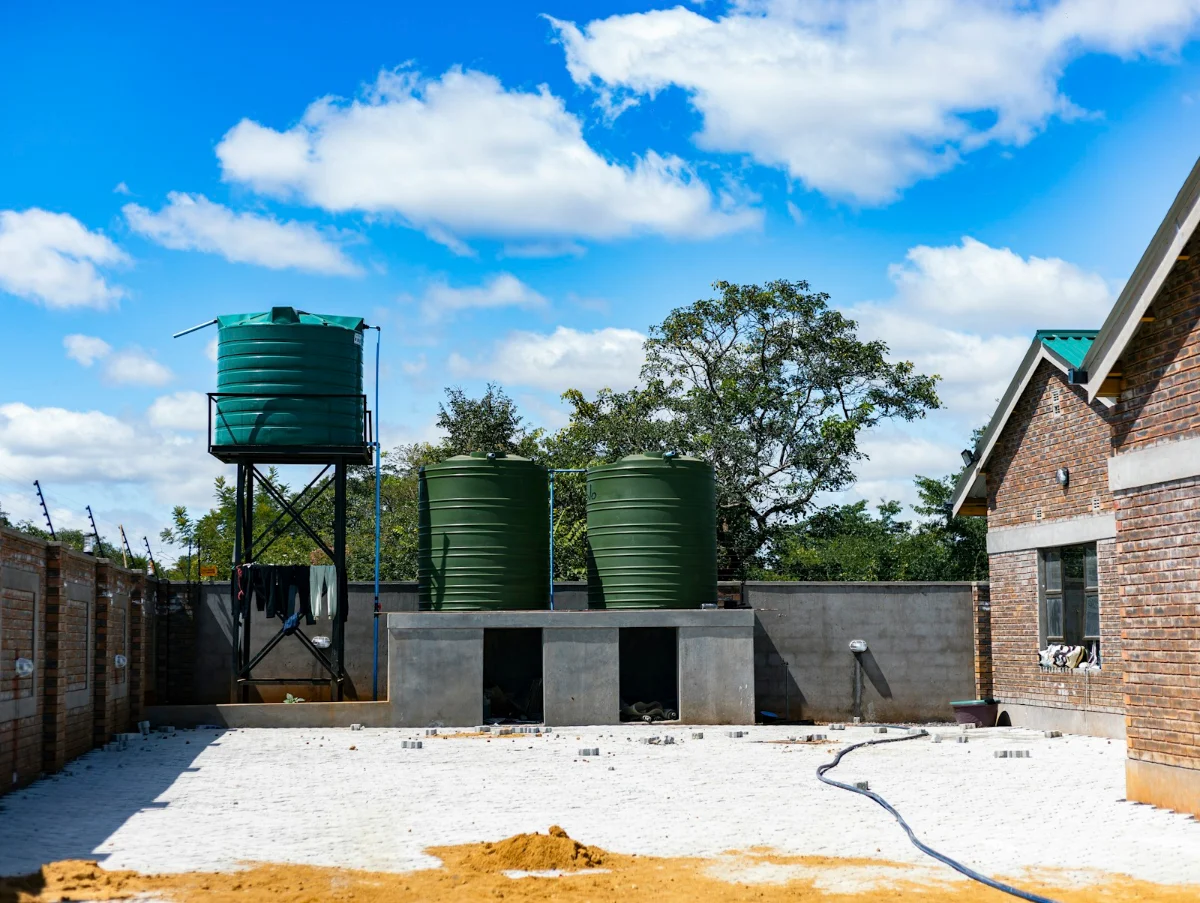
Short answer. How to save water at home in South Africa comes down to three things: fix leaks, cut what goes down the toilet and shower, and water the garden less often, early or late, under mulch. Those are the biggest uses in most homes, and much of the advice below comes from the City of Cape Town’s guidance during and since the 2017 to 2018 drought. A rainwater tank helps most when its water goes to a steady, year-round use such as flushing toilets. Bath, shower and basin water can go on the garden if it is used within 24 hours and kept off leafy and root vegetables. Tank water is not automatically safe to drink: roofs collect droppings and other contamination, and a study of household tanks in Kleinmond detected DNA from disease-linked bacteria and parasites. Where you rely on it, maintain the roof and tank, treat what you drink and have it tested at a SANAS-accredited laboratory.
On this page
- Are there water restrictions in South Africa right now?
- Where does the water go in a South African home?
- How to save water at home in South Africa: indoor quick wins
- How to save water in the garden
- Is a rainwater tank worth it?
- Can you drink tank water?
- How to use greywater safely
- What about boreholes and wellpoints?
- Frequently asked questions
Are there water restrictions in South Africa right now?
Updated 13 November 2026. Restrictions can change at short notice, so check the links under “How to check for updates” for the latest.
Cape Town and the Western Cape
Dam levels (as at 12 November 2026). The dams that supply Cape Town held 71.3% of capacity, against 85.4% in the same week last year (City of Cape Town, dam levels). Voëlvlei was at 52.5% and Steenbras Lower at 46.1%.
Provincial advice (28 October 2026). In a Local Government Circular, the Western Cape Government advised municipalities to bring in at least Level 1 restrictions by 15 November, and Level 2 by 1 December where supply systems face higher risk. Minister Anton Bredell called it “a precautionary step”, adding: “We are not in a province-wide water crisis” (Western Cape Government statement, as published by the Knysna-Plett Herald, 28 Oct 2026). Each municipality sets its own rules for each level.
National assessment (as at 13 November 2026). The national Department of Water and Sanitation (DWS) scheduled its annual operating analysis meeting for the Western Cape for 2 November, to review the water situation and consider whether restrictions are needed (EWN, 14 Oct 2026). EWN reported that DWS would share its findings in November, that the City of Cape Town would then set its own rules, and that restrictions could start as early as December (EWN, 23 Oct 2026). In the same report, climate scientist Peter Johnston expected the first measures to target waste, such as overfilled pools and heavy garden watering. On 11 November the City said the outcome of the DWS assessment would determine whether restrictions are imposed on users of the Western Cape Water Supply System, which includes Cape Town; we found no announcement of the outcome as at 13 November (SAnews, via allAfrica, 11 Nov 2026).
City of Cape Town (as at 11 November 2026). No restrictions had been announced. On 3 November the City’s restrictions page said “No water restrictions are currently in place”, with the City “closely monitoring the situation” (City of Cape Town, water restrictions explained). On 11 November it said use had risen to 912 million litres a day, above the collective target of 860 million, and that household use needs to drop by at least 10% over summer and into winter (SAnews, as above). The City’s permanent water by-law rules, covered in the garden section, apply at all times, even when there are no restrictions.
Gauteng
Vaal Dam (as at 6 October 2026, the latest DWS figure found). Gauteng’s dams are close to full: DWS put the Vaal Dam at 95.4% (DWS). The strain is on delivery.
Rand Water (23 October 2026). Rand Water said it would restrict bulk supply to Johannesburg and Tshwane if they kept drawing more than their allocations: Johannesburg averaged 1,724 million litres a day in September against 1,528 million allowed (Mail & Guardian, 23 Oct 2026). No start date was given.
Tshwane (27 October 2026). The City of Tshwane introduced targeted overnight restrictions at 14 reservoirs to cut high use and ease strain on Rand Water’s system (TimesLIVE, 27 Oct 2026).
Johannesburg (as at 3 November 2026). Parts of the city had outages and low pressure from 19 October; on 2 November Mayor Dada Morero said supply was improving and storage had risen to 41% (SAnews, 3 Nov 2026), and Johannesburg Water asked residents to cut use by 15% (EWN, 3 Nov 2026). Johannesburg Water’s seasonal Level 1 restrictions apply from 1 September 2026 to 31 March 2027: no watering gardens or filling pools between 06:00 and 18:00, and no hosing down paving or driveways (Johannesburg Water, 15 Sept 2026). On 29 October it proposed stricter Level 1 measures, including compulsory spray nozzles on hosepipes and no dampening of building sand with drinking water, aimed at cutting demand by about 15%. It said further restrictions would be announced through official channels before they take effect (Johannesburg Water, 29 Oct 2026).
How to check for updates
Cape Town publishes weekly dam levels and a water restrictions page. Elsewhere, check your own municipality’s notices, and in Johannesburg, Johannesburg Water’s daily water notices.
Where does the water go in a South African home?
Where there is a garden, it is often the biggest user. A City of Cape Town pamphlet says gardens can use 40% to 60% of a home’s water (City of Cape Town, Alternative Water Resources), and UCT’s Dr Kirsty Carden told Africa Check that outdoor use is often quoted as about half of residential demand over a year (Africa Check).
Indoors, in estimates for Johannesburg homes, toilets, baths, showers and washing machines made up 81.5% of use (Jacobs, Ilemobade and Botha, 2017). The City of Cape Town’s water cheat sheet names the toilet as the biggest indoor user and puts an average flush at 11 litres and a five-minute shower at 80 litres (City of Cape Town, water cheat sheet).
How to save water at home in South Africa: indoor quick wins
Find leaks first
A leak runs day and night. The City of Cape Town says one leaking toilet wastes 2,600 to 13,000 litres a month and a leaking tap 400 to 2,600 litres (City of Cape Town, saving water). Its two checks (City of Cape Town, 2021):
- Meter test. Close every tap and don’t flush. Note the meter reading, wait at least 15 minutes without using water, and read it again. If it has moved, there’s a leak.
- Toilet test. Put 15 drops of food colouring in the cistern. If the bowl water has changed colour after 15 minutes, the cistern is leaking.
The City advises calling a plumber unless it’s a simple DIY job, and if you can’t afford one for a serious toilet problem, points to the angle valve at the base of the toilet. Closing it stops the leak; open it only to refill the cistern before a flush.
Toilets, showers and taps
Cape Town’s by-law limits new or replacement cisterns to 6 litres, showerheads to 7 litres a minute and basin taps to 6 litres a minute. At 7 litres a minute a five-minute shower uses 35 litres, under half the City’s 80-litre estimate. A dual-flush mechanism, or a filled bottle in an older cistern, uses less per flush (A Water-Efficient Home, a household guide from the Water Research Commission’s WaterWise Nation campaign); check that the toilet still clears. Under the 2018 Level 6B restrictions, the City encouraged flushing with greywater or rainwater by bucket (City of Cape Town, 2018). Catch the cold water that runs while the shower warms up; the City’s greywater booklet calls it low-risk if collected in a clean container and used straight away.
Kitchen and laundry
Run the dishwasher and washing machine only when full, wash vegetables in a bowl rather than under a running tap, and keep drinking water in the fridge instead of running the tap until it’s cold (WRC, A Water-Efficient Home).
How to save water in the garden
- Water early or late. Cape Town’s by-law allows watering with municipal water only before 09:00 or after 18:00, and the City recommends the same hours for borehole and wellpoint water (City of Cape Town, 2022). Hosepipes need a spray nozzle or self-closing device, and hosing down paving with municipal water isn’t allowed.
- Water less, and aim sprinklers. The City’s cheat sheet says over 50% of water applied to lawns is lost to evaporation or run-off, mainly from overwatering or watering in the heat of the day, and that an open hose runs at about 30 litres a minute.
- Mulch. The City recommends compost and mulch twice a year to hold moisture, with stones where wind blows bark away (Alternative Water Resources). Drip irrigation under mulch wastes less than spraying.
- Plant for the climate. Indigenous shrubs and plants with grey, waxy or hairy leaves need less water. Group plants with similar needs so you water only the beds that need it, and keep lawn to the areas you use.
- Cover the pool. Cape Town requires a cover when the pool isn’t in use and bans float-valve top-ups from municipal water.
Is a rainwater tank worth it?
Each millimetre of rain on a square metre of roof gives about a litre; the City of Cape Town’s example is 500 litres from 5 mm on a 100 m² roof (City of Cape Town, alternative water sources). A tank saves water only when it is emptied and refilled, so it works best on a use that runs all year.
Sizing a tank
- Work out the catchment. Roof footprint in square metres times rainfall in millimetres gives litres before losses: 20 mm on a 120 m² roof is up to 2,400 litres.
- Match it to the season. The City notes tanks can be more useful in summer-rainfall areas than in winter-rainfall areas such as Cape Town, where a few thousand litres won’t last long on the garden in the dry summer months. Even so, it says a 5,000-litre tank used mainly to flush toilets in a winter-rainfall area could save up to 15% of a year’s water use (Alternative Water Resources; City of Cape Town, guidelines, below).
- Check whether you need plans. In Cape Town, tanks over 10,000 litres, tanks over 1,000 litres built on site from masonry, concrete or steel, and tanks on a stand more than 1 m high need building plan approval (City of Cape Town, guidelines).
First flush, cleaning and mosquitoes
The first water off a roof washes down dust, leaves and droppings. enHealth, a committee of Australian government health officials, suggests diverting the first 20 to 25 litres from an average roof with a first-flush diverter that is kept empty and checked (enHealth, 2010). Its routine:
- Every six months, inspect the roof, gutters, tank inlets, insect screens and leaf filters. NSW Health suggests clearing gutters every three or four months (NSW Health).
- Every two to three years, check the tank for sludge and remove it.
- Keep light out with a fully roofed, opaque tank, which stops algae.
- Screen every inlet and overflow with insect-proof mesh to keep mosquitoes from breeding; enHealth cites a Queensland standard of no coarser than 1 mm.
- Cut back overhanging branches, which give birds a perch over the roof.
The rules in Cape Town
A tank can feed toilet cisterns, but a system plumbed into the house needs City permission first, applied for on City Connect. Rainwater must never be able to reach the municipal supply: the City requires a reduced pressure zone (RPZ) backflow valve, or an air-gap tank, and its guidelines say non-return valves and standard stopcocks aren’t enough. “Do not drink” signs are required at the gate and at points of use (City of Cape Town, summary guide). Elsewhere, check your municipality’s water by-law before plumbing a tank in.
Can you drink tank water?
Not without treating and testing it. If you have a municipal supply, drink that and keep tank water for other uses. Most of the contamination comes from the roof, gutters and tank rather than the rain. enHealth and NSW Health list:
- Droppings from birds, lizards and rodents, and dead animals in gutters or tanks. enHealth links bird droppings to bacteria such as Salmonella and Campylobacter.
- Roofing materials. Uncoated lead flashing, lead-based paint and lead washers on roofing screws can release lead, especially into slightly acidic rainwater. enHealth says roofs used to collect drinking water should not include uncoated lead flashing.
- Ash after fires, which enHealth says mainly affects colour, cloudiness and taste rather than health. It treats emissions from heavy industry as a risk only in places right beside it.
A local study bears this out. Researchers sampled 29 tanks at a housing project in Kleinmond four times between June and August 2012. They detected DNA from bacterial groups that include disease-causing species, among them Legionella in 73% of samples and Salmonella in 6%, and detected Giardia DNA in two of the eight tanks tested for parasites. The genetic tests didn’t show whether these organisms were alive. The authors, funded by the Water Research Commission and the National Research Foundation, concluded that drinking untreated harvested rainwater “could thus pose a potential significant health threat” (Dobrowsky et al., 2014).
The City of Cape Town says rainwater should not be used for drinking, food preparation or body washing. NSW Health recommends that people in towns and cities use the public supply for drinking and cooking, and enHealth says that where a treated public supply exists, tank water can go to uses such as toilet flushing, laundry and the garden. Where people do drink it, enHealth says the risk of illness is low if the water is clear, has little taste or smell, and comes from a well-maintained roof and tank.
If tank water is your drinking water
- Maintain the system as above.
- Treat what you drink. Bringing water to the boil disinfects it, says enHealth. Our guide to whether tap water is safe to drink in South Africa covers boiling and the bleach method. Boiling deals with germs, not lead or other chemicals.
- Treat the tank only when something’s wrong, such as after finding a dead animal, when enHealth advises draining and cleaning it. It says regular chlorination of a domestic tank is “not considered appropriate in most cases”. That is about dosing the whole tank, not the bleach method for a container of drinking water in step 2.
- Test it. Looking at the water won’t tell you what’s in it. The City of Cape Town tells users of alternative water to test it at a SANAS-accredited laboratory first. Ask for a test against SANS 241 covering microbiological and chemical results, including lead if the roof has old flashing or paint, and retest if the taste, smell or colour changes. The SANAS website lists accredited laboratories.
If you are pregnant, are preparing formula for a baby, or someone at home has a weakened immune system, ask your doctor or clinic how to handle tank water.
How to use greywater safely
Greywater is used water from baths, showers and hand basins, plus laundry water where environmentally friendly detergents are used; rinse water is the lowest-risk part of a wash. The City of Cape Town’s Safe Use of Greywater booklet (Nov 2022) advises:
- Use it within 24 hours. Don’t store it longer.
- Flush by pouring into the bowl with a jug or bucket, never into the cistern, where it could flow back into the drinking water supply.
- Water the soil, not the plants. Don’t spray it. Use drip or subsurface irrigation under mulch, avoid pooling, keep it away from where people and pets go, water at night, and don’t irrigate within 48 hours of rain.
- Food gardens: roots only, and never on leafy vegetables such as spinach or root vegetables such as carrots.
- Watch the soil, which can build up salts and turn alkaline over time.
Don’t reuse kitchen sink or dishwasher water, which carries grease, oils, bacteria and food particles; toilet, spa or pool water; or nappy-washing water. Don’t use greywater if anyone at home is ill, never drink it, keep children and animals away, wash your hands after handling it, and keep it out of stormwater drains. In Cape Town, plumbed systems and greywater irrigation need City approval, signage is required, and the City says use is at your own risk.
What about boreholes and wellpoints?
In Cape Town, notify the City at least 14 days before installing a borehole or wellpoint and register it afterwards; registration is free and comes with a sign to display. National rules from January 2018 require borehole use to be metered (City of Cape Town, alternative water sources). The City recommends keeping to its watering hours, and it says groundwater may not generally be used for drinking, cooking or body washing. If you depend on a borehole for drinking water, the borehole section of our tap water guide covers what local groundwater can contain and how to test it.
Frequently asked questions
Are there water restrictions in Cape Town in 2026?
Not as at 11 November 2026: the City had announced no restrictions, and its permanent by-law rules apply at all times. The City says the outcome of the national water department’s Western Cape assessment will decide whether restrictions come in, and the Western Cape Government has advised municipalities to bring in at least Level 1 by 15 November. Check the City’s restrictions page for the latest.
Can you drink water from a JoJo tank?
The brand matters less than the roof, gutters and maintenance. Water in any tank can pick up germs from droppings and lead from old flashing or paint on the roof. If it is your only supply, maintain it, boil or treat what you drink, and have it tested at a SANAS-accredited laboratory.
Is rainwater safe to drink if you boil it?
Boiling disinfects it but doesn’t remove lead or other chemicals, so a lab test is still worth doing, especially on an older roof.
Can I connect my rainwater tank to my house plumbing?
In Cape Town, yes, for uses such as toilet flushing, with City approval, an RPZ valve or air-gap tank, and “Do not drink” signs. Elsewhere, check your municipality’s by-law.
Can I water my vegetables with greywater?
Only at the roots, by drip or subsurface irrigation under mulch, never on leafy or root vegetables, and never with kitchen water.
When can I water my garden in Cape Town?
With municipal water, before 09:00 or after 18:00, with a spray nozzle or self-closing device on the hose. The City recommends the same hours for borehole water. Restrictions may tighten this.
Do I need to register a borehole in Cape Town?
Yes. Notify the City 14 days before installing it, register it afterwards and meter its use.
Sources
All opened and checked on 3 Nov 2026 unless noted.
- City of Cape Town. “This week’s dam levels” (figures for 12 Nov 2026, checked 13 Nov 2026). https://www.capetown.gov.za/family-and-home/residential-utility-services/residential-water-and-sanitation-services/this-weeks-dam-levels/
- City of Cape Town. “Water restrictions explained” (undated status text; checked 3 Nov 2026). https://www.capetown.gov.za/family-and-home/greener-living/water-wise-in-the-home/water-restrictions-explained/
- Western Cape Government (contributor: Minister Anton Bredell). “Western Cape calls for early water restrictions as summer approaches,” published by the Knysna-Plett Herald, 28 Oct 2026, reporting the Local Government Circular issued that day. https://www.knysnaplettherald.com/News/Article/national-news/western-cape-calls-for-early-water-restrictions-as-summer-approaches-202610280235 (the same text appears in the George Herald, credited to “Anton Bredell, Western Cape Government”; Cape Town ETC, 29 Oct 2026, https://www.capetownetc.com/news/western-cape-water-restrictions/, reports the same dates. The circular itself was not found on westerncape.gov.za or gov.za)
- EWN. “WC DWS to continue monitoring dam levels ahead of key water assessment,” 14 Oct 2026 (meeting scheduled for 2 Nov 2026). https://www.ewn.co.za/2026/10/14/wc-dws-to-continue-monitoring-dam-levels-ahead-of-key-water-assessment
- EWN. “Cape Town could face water restrictions by December,” 23 Oct 2026 (DWS findings in November; the City then sets its own rules; Peter Johnston’s comments). https://www.ewn.co.za/2026/10/23/cape-town-could-face-water-restrictions-by-december
- Department of Water and Sanitation. “Water and Sanitation on Vaal Dam reservoir levels,” 6 Oct 2026. https://www.gov.za/news/media-statements/water-and-sanitation-vaal-dam-reservoir-levels-06-oct-2026
- Mail & Guardian. “Rand Water to restrict water supply to Johannesburg and Tshwane,” 23 Oct 2026. https://mg.co.za/the-green-guardian/2026-10-23-rand-water-to-restrict-water-supply-to-johannesburg-and-tshwane/
- Johannesburg Water. “Johannesburg Water implements urgent interventions to stabilise severely constrained systems,” 29 Oct 2026. https://www.johannesburgwater.co.za/blog/2026/10/29/johannesburg-water-implements-urgent-interventions-to-stabilise-severely-constrained-systems/ (also on joburg.org.za as a PDF media statement)
- Johannesburg Water. “Level 1 water restrictions are here, let’s make every drop count,” 15 Sept 2026. https://www.johannesburgwater.co.za/blog/2026/09/15/level-1-water-restrictions-are-here-lets-make-every-drop-count/ ; daily water notices: https://www.johannesburgwater.co.za/daily-water-notices/
- City of Cape Town. Alternative Water Resources, pamphlet 1 of 4 (undated). https://www.capetown.gov.za/_documents/resource.capetown.gov.za/documentcentre/Documents/Graphics%20and%20educational%20material/Alternative_Water_Resources_3Ways_English.pdf
- Africa Check. “Do formal residents use 65% of Cape Town’s water, with half going to gardens and pools?” (undated; data from 2015/16 to 2016/17). https://africacheck.org/fact-checks/reports/do-formal-residents-use-65-cape-towns-water-half-going-gardens-pools
- Jacobs HE, Ilemobade AA, Botha BE. “End-use estimates of water demand within certain residential categories in the City of Johannesburg,” CCWI 2017, University of Sheffield repository. https://figshare.shef.ac.uk/articles/CCWI2017_F101_END-USE_ESTIMATES_OF_WATER_DEMAND_WITHIN_CERTAIN_RESIDENTIAL_CATEGORIES_IN_THE_CITY_OF_JOHANNESBURG_/5364556/1
- City of Cape Town. Smart Office Toolkit: Water Cheat Sheet (undated). https://www.capetown.gov.za/_documents/resource.capetown.gov.za/documentcentre/Documents/Procedures,%20guidelines%20and%20regulations/SOH_Audit_Water_cheat_sheet.pdf
- City of Cape Town. “Saving water.” https://www.capetown.gov.za/family-and-home/greener-living/water-wise-in-the-home/saving-water/
- City of Cape Town. “How to find and fix leaks on your property to avoid excessive usage and warning letters,” 10 Sept 2021. https://www.capetown.gov.za/Media-and-news/How%20to%20find%20and%20fix%20leaks%20on%20your%20property%20to%20avoid%20excessive%20usage%20and%20warning%20letters
- City of Cape Town. “Tips to be water wise at all times,” 1 March 2022. https://www.capetown.gov.za/Media-and-news/Tips%20to%20be%20water%20wise%20at%20all%20times
- Water Research Commission, A WaterWise Nation campaign. A Water-Efficient Home: Smart Habits for Big Savings (no publisher or date printed on the guide). https://wrcwebsite.azurewebsites.net/wp-content/uploads/A-Water-Efficient-Home-Smart-Habits-for-Big-Savings.pdf (that “A WaterWise Nation”, tagline “Act Today. Sustain Tomorrow.”, is the WRC’s campaign is confirmed by Infrastructure News, 9 Dec 2025, https://infrastructurenews.co.za/2025/12/09/the-water-research-commission-launches-a-waterwise-nation-this-summer-season-as-cities-race-to-save-water/)
- City of Cape Town. Level 6B Water Restrictions, effective 1 Feb 2018, hosted by the Western Cape Government. https://d7.westerncape.gov.za/text/2018/January/level_6b_water_restriction_guidelines-_eng.pdf
- City of Cape Town. “Alternative water sources.” https://www.capetown.gov.za/Family%20and%20home/greener-living/water-wise-in-the-home/alternative-water-sources
- City of Cape Town. Guidelines for the Installation of Alternative Water Systems in Cape Town, first edition. https://resource.capetown.gov.za/documentcentre/Documents/Procedures,%20guidelines%20and%20regulations/Guidelines%20for%20Alternative%20Water%20Installations.pdf
- City of Cape Town. Summary guide to installation of alternative water systems (undated). https://resource.capetown.gov.za/documentcentre/Documents/Procedures%2C%20guidelines%20and%20regulations/Summary%20guide%20to%20installation%20of%20alternative%20water%20systems.pdf
- City of Cape Town. Safe Use of Greywater, November 2022. https://resource.capetown.gov.za/documentcentre/Documents/Graphics%20and%20educational%20material/Safe%20Use%20of%20Greywater%20booklet.pdf
- enHealth (Australian Government). Guidance on use of rainwater tanks, third edition, 2010. https://www.cdc.gov.au/system/files/2025-10/enhealth-guidance-the-use-of-rainwater-tanks.pdf
- NSW Health. “Rainwater tanks,” current as at 11 Sept 2026. https://www.health.nsw.gov.au/environment/water/Pages/rainwater.aspx
- Dobrowsky PH, De Kwaadsteniet M, Cloete TE, Khan W. “Distribution of indigenous bacterial pathogens and potential pathogens associated with roof-harvested rainwater.” Applied and Environmental Microbiology 2014; 80(7): 2307–16. https://pmc.ncbi.nlm.nih.gov/articles/PMC3993141
- South African National Accreditation System (SANAS). https://www.sanas.co.za/ (opened 2 Nov 2026)
- SAnews (via allAfrica). “Cape Town residents urged to use water sparingly,” 11 November 2026. https://allafrica.com/stories/202611110501.html
- SAnews. “Johannesburg water supply improving, says Morero,” 3 November 2026. https://www.sanews.gov.za/node/85387
- EWN. “Joburg water crisis: residents urged to cut consumption by 15%,” 3 November 2026. https://ewn.co.za/2026/11/03/joburg-water-crisis-residents-urged-to-cut-consumption-by-15
- TimesLIVE. “Tshwane introduces overnight water restrictions at 14 reservoirs,” 27 October 2026. https://www.timeslive.co.za/news/south-africa/2026-10-27-tshwane-introduces-overnight-water-restrictions-at-14-reservoirs/