

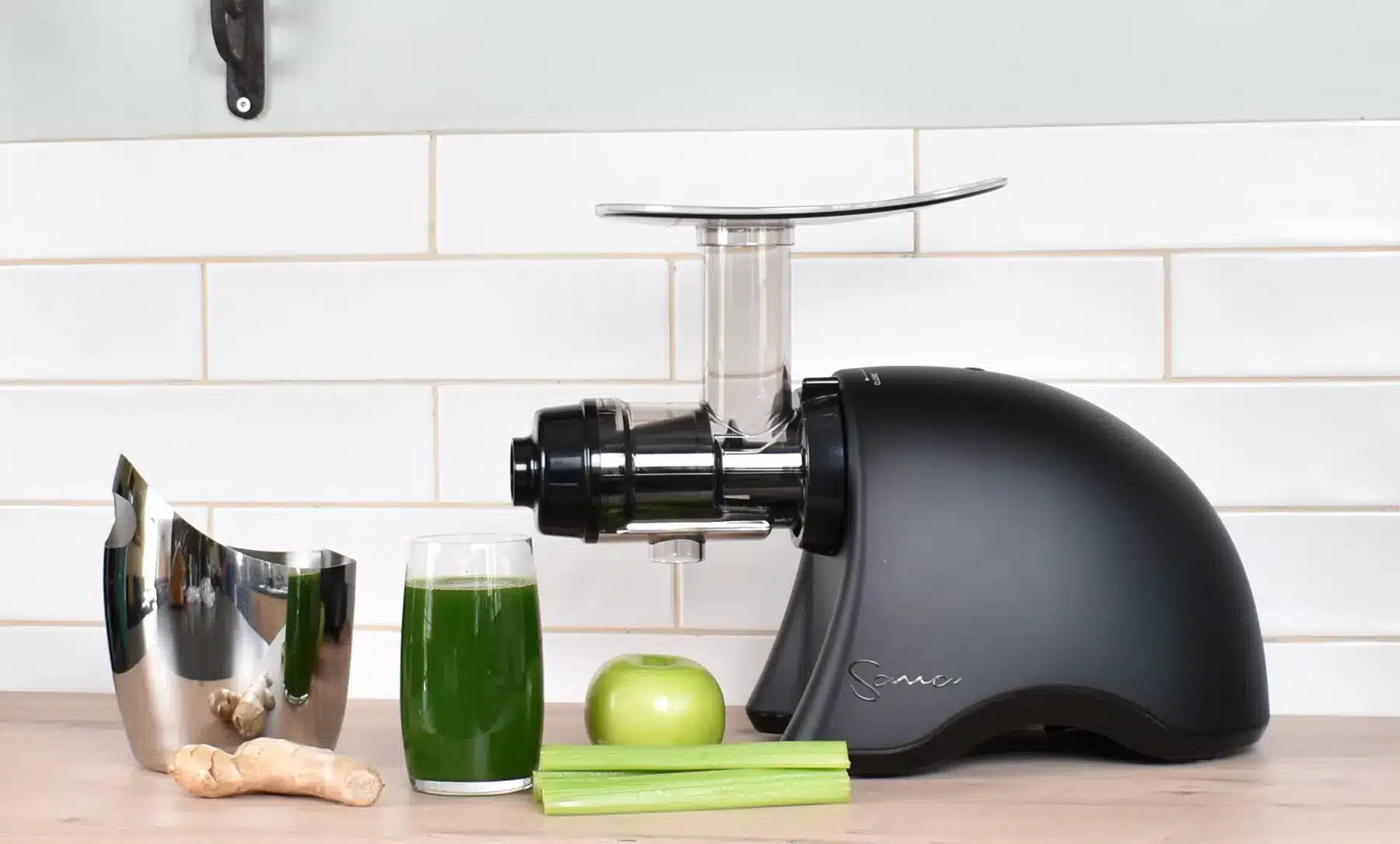
Short answer. The horizontal vs vertical juicer choice comes down to what goes into the glass. A horizontal slow juicer turns one auger laid flat in a drum: you feed it by hand, and it grips and presses celery, leafy greens, wheatgrass, ginger and turmeric, pushing the fibre out as dry pulp. A vertical slow juicer stands its auger upright under a wide chute or a large hopper, which saves preparation time and suits fruit-led juice and bigger batches, provided long fibres such as celery are cut short first. Both are cold-press machines turning slowly. If your juice is mostly greens, choose a horizontal; if it is mostly fruit for a household, choose a vertical.
On this page
- What is the difference between a horizontal and a vertical juicer?
- Horizontal vs vertical juicer at a glance
- Why horizontals suit celery, leafy greens and wheatgrass
- Why verticals suit fruit and bigger batches
- Which is the best juicer for celery?
- What if you are replacing an Oscar juicer?
- Which design should you choose?
- What about cleaning and counter space?
- Frequently asked questions
What is the difference between a horizontal and a vertical juicer?
Both designs use a screw-shaped auger that turns slowly and presses produce against a fine screen. The juice runs out through the screen and the pulp is pushed out separately. What changes is the direction of the auger, and that changes how produce is fed and how fibre behaves.
In a horizontal juicer the auger sits flat inside a drum. You drop produce down a chute at one end, the auger draws it along, crushes it and squeezes it against the screen, and the dry pulp leaves through an end cap. The Sana 707 turns at 63 to 75 rpm and the compact Hurom DU at 64 rpm. The Sana 727 Supreme and 929 Ultimate let you choose from four speeds between 40 and 120 rpm.
In a vertical juicer the auger stands upright inside a bowl, so gravity helps the produce down onto it. Most turn at around 50 rpm. Verticals come in two kinds:
- Wide-chute verticals, such as the Kuvings B1700 (a 76 mm chute) and the Kuvings REVO830 (an 82 mm chute plus a narrower 45 mm chute and an auger with a self-cutting top). You still feed them, but in larger pieces.
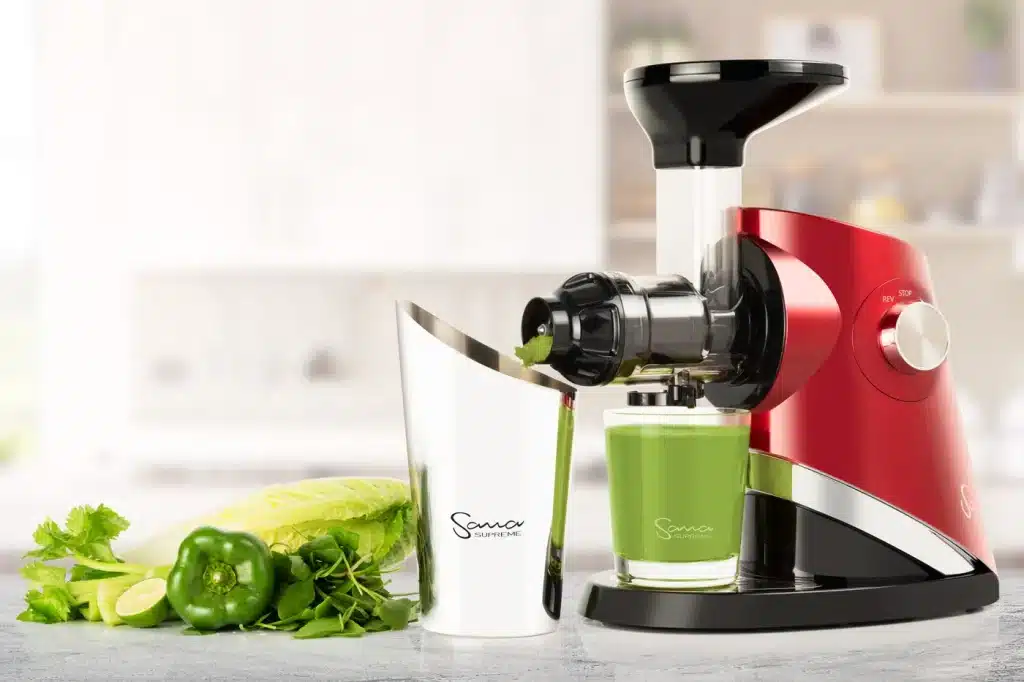
- Hands-free or self-feeding verticals, which have a hopper on top with blades that cut and feed the produce while you do something else. Examples are the Sana 878 (2-litre hopper), Sana 818 (1,600 ml), Kuvings AUTO10 (3 litres), Kuvings AUTO 6 (1.7 litres), DNA Cold Flow (1.8 litres) and the OmniKitchen OmniJuice.
Horizontal vs vertical juicer at a glance
| Horizontal | Vertical, wide chute | Vertical, hands-free | |
|---|---|---|---|
| How it feeds | By hand, piece by piece, down a narrow chute | By hand, in larger pieces | Load the hopper and switch on |
| Preparation | Cut produce to fit the chute | Less cutting; some whole fruit fits | Cut to fit the hopper; core apples |
| Strongest with | Celery, leafy greens, wheatgrass, ginger, turmeric, carrot, beetroot | Mixed fruit and vegetables, soft fruit | Fruit-led juice: apple, orange, pineapple, pear, carrot, watermelon |
| Long fibres | Pressed and pushed out as pulp | Cut short before feeding | Cut short and mix in with firmer fruit |
| Batch size | One glass to a few litres, at your pace | Medium | Large, with little hands-on time |
| Shape on the counter | Low and long | Tall | Tall, with a hopper on top |
| At EcoHub | Sana 707, 727, 929; Hurom DU | Kuvings REVO830, B1700 | Sana 878, 818; Kuvings AUTO10, AUTO 6; DNA Cold Flow; OmniJuice |
Why horizontals suit celery, leafy greens and wheatgrass
Leaves and stringy stalks are light and fibrous. A horizontal auger grips them, draws them along the drum and keeps pressing until only dry pulp is left, rather than letting long strands wrap around the screw. That is why the design has long been the first choice for wheatgrass, kale, spinach, herbs and celery, and why it handles dense roots such as ginger and turmeric well. Independent reviewers at UK Juicers describe horizontal single-auger juicers as particularly good for leafy greens and wheatgrass, while noting that the better vertical slow juicers come close and are easier to use.
Horizontals are not greens-only machines. Carrot, beetroot, apple and citrus juice well too; the 727, for example, has higher speeds for juicy, low-fibre produce such as oranges. The trade-off is time: you feed a horizontal by hand, so a large batch of fruit juice takes longer at the counter than it would in a hands-free machine.
Leafy greens give little juice in any juicer, so expect a small yield from kale. Feeding leaves together with firmer produce such as cucumber or apple helps; SanaStore’s celery, ginger and lemon green juice has practical tips on getting more from kale.
Why verticals suit fruit and bigger batches
A vertical juicer lets gravity do part of the work. With a wide chute you can feed larger pieces, and a hands-free hopper takes a whole recipe at once: the Sana 878 accepts peeled oranges and small apples whole (with apple cores removed), and the Kuvings AUTO10 holds 3 litres of washed, cut produce. For a family that wants a jug of apple, carrot and orange juice before school, that saving in hands-on time is the main reason to choose one.
Verticals do their best work with juicy, firm produce: apple, orange, pineapple, pear, carrot, beetroot, cucumber and watermelon. Greens, celery and ginger work too, but long fibres need cutting first so they can’t wrap around the upright auger. Sana recommends cutting celery and leafy greens into pieces of about 3 cm for the 878, and Kuvings recommends celery in 2.5 to 5 cm lengths. Put soft, leafy produce at the bottom of a hopper and firmer fruit on top, and treat greens as part of a fruit-led juice rather than the whole of it.
Many verticals also come with extra strainers. The Sana 878 has a sorbet screen, and the Kuvings AUTO10 and REVO830 have smoothie and sorbet strainers.
Which is the best juicer for celery?
If most of what you juice is celery, a horizontal is the better tool. Each of these horizontals presses celery well and has a feature aimed at it:
- Sana 707, the workhorse: a single-speed horizontal at 63 to 75 rpm with a celery insert in the box for higher yield from celery and leafy greens.
- Sana 727 Supreme, the flagship: a brushless motor with four speeds (40 rpm suits celery, greens and roots), no run-time limit, and a rotating stainless blade at the pulp outlet that gives the pulp a final cut and squeeze.
- Sana 929 Ultimate, the pinnacle: solid stainless steel auger, drum and screens, an adjustable pressure cap for fibrous produce, and the same four speeds.
- Hurom DU: a slim horizontal at 64 rpm with a cutting blade in the end cap that chops the pulp as it leaves.
Even on a horizontal, Sana’s manuals ask for celery to be cut into short lengths of about 3 to 4 cm before feeding. If celery is one ingredient among several, a vertical will handle it once it is cut short. SanaStore has a full method for celery juice on a horizontal juicer.
What if you are replacing an Oscar juicer?
Many South Africans know the horizontal juicer as the Oscar juicer. If you’ve owned or are replacing a horizontal juicer such as an Oscar, the Sana 707 works the same way. It was previously sold as the Oscar Classic DA-950, it is made in South Korea by Hurom, and it now comes with a celery insert. The feeding, the pulp outlet and the way it handles greens will feel familiar. If you want more control, the 727 Supreme adds four speeds and continuous running.
Which design should you choose?
Start with what you will juice most days, not with what you might juice occasionally.
- Mostly greens, celery, wheatgrass, ginger or turmeric shots: a horizontal. The Sana 707 is the workhorse, the 727 Supreme the flagship and the 929 Ultimate the pinnacle; the Hurom DU is the most compact.
- Fruit-led juice for a household, in bigger batches, with little time to prepare: a hands-free vertical. The Sana 878 brings a 2-litre hopper, a vacuum juice container and a stainless pulp container; the Sana 818 is the compact, affordable way into hands-free juicing. The Kuvings AUTO10 has the largest hopper at 3 litres, and the Kuvings AUTO 6, DNA Cold Flow and OmniJuice cover the entry price range.
- A mix of fruit and vegetables from a wide chute, fed by hand: a wide-chute vertical such as the Kuvings REVO830 or Kuvings B1700.
If you are choosing between Sana models, SanaStore’s guide Which Sana juicer suits you? compares all five side by side. For a wider look at juicer types, including commercial machines, see how to choose a cold-press juicer in South Africa, or browse all juicers.
What about cleaning and counter space?
A horizontal has few parts: drum, auger, screen and end cap. It is low and long, so it slides under wall cupboards easily; the Sana 707 measures 420 × 187 × 320 mm. Verticals are taller, especially hands-free models with a hopper on top: the Kuvings REVO830 stands 480 mm high and the DNA Cold Flow 50 cm, so measure the space under your cupboards before you buy. A vertical’s bowl and screen usually come with a rotating brush, and hands-free models add a hopper to rinse.
Whatever the design, rinse the parts straight after juicing, before pulp dries on the screen, and follow the manual: some ask you not to use the dishwasher, hot water or dishwashing liquid on certain parts.
Frequently asked questions
Is a horizontal or vertical juicer better for leafy greens?
A horizontal single-auger juicer is the stronger choice for leafy greens and wheatgrass, because the auger grips and presses light, fibrous leaves along the drum. Good vertical slow juicers come close, especially when greens are mixed with firmer produce, and they are quicker to feed.
Can a vertical juicer juice celery?
Yes, if you cut it short first. Sana recommends pieces of about 3 cm for the 878, and Kuvings recommends 2.5 to 5 cm lengths, so the strings can’t wrap around the upright auger. Mixed with firmer fruit, celery juices well in a vertical. If your juice is mostly celery, a horizontal is the better fit.
Is the Sana 707 the same as an Oscar juicer?
The Sana 707 was previously sold as the Oscar Classic DA-950. It is a horizontal single-auger juicer made in South Korea by Hurom, it works the same way as the Oscar, and it now includes a celery insert. If you are replacing an Oscar, it will feel familiar.
Are horizontal juicers slower to use?
They take longer to feed, because you put produce in piece by piece. For one or two glasses of green juice the difference is small. For a large jug of fruit juice, a hands-free vertical that you load once and leave is much quicker in hands-on time.
Are horizontal and vertical juicers both cold press juicers?
Yes. Both are slow, single-auger juicers that press produce rather than shredding it with a fast-spinning blade. The machines in this article turn at between 40 and 120 rpm. The names cold press, slow and masticating juicer all describe the same idea.
What about twin gear juicers?
A twin gear juicer, such as the Angel 5500, presses produce between two interlocking gears instead of a single auger. The Angel’s gears are stainless steel and turn at 86 rpm. It is a specialist horizontal design for people who want that construction; for most households the choice is between a single-auger horizontal and a vertical.
Sources
- Sana 707 Cold Press Juicer, EcoHub: Oscar Classic DA-950 history, speed, celery insert, dimensions and origin. ecohub.co.za
- Sana 727 Supreme, EcoHub: speeds, run time, pulp-outlet blade and suitable produce. ecohub.co.za
- Sana 878 Hands-Free Batch Juicer, EcoHub: hopper, whole fruit, 3 cm celery and greens. ecohub.co.za
- Kuvings AUTO10, EcoHub: hopper size and Kuvings’ 2.5 to 5 cm celery advice. ecohub.co.za
- Sana 878 user manual, Sana Products: preparing celery and leafy greens. sanaproducts.com
- Sana 727 Supreme user manual, Sana Products: preparing produce and cleaning. sanaproducts.com
- Which is the best juicer?, UK Juicers: horizontal, vertical and centrifugal juicers compared by ingredient. ukjuicers.com