

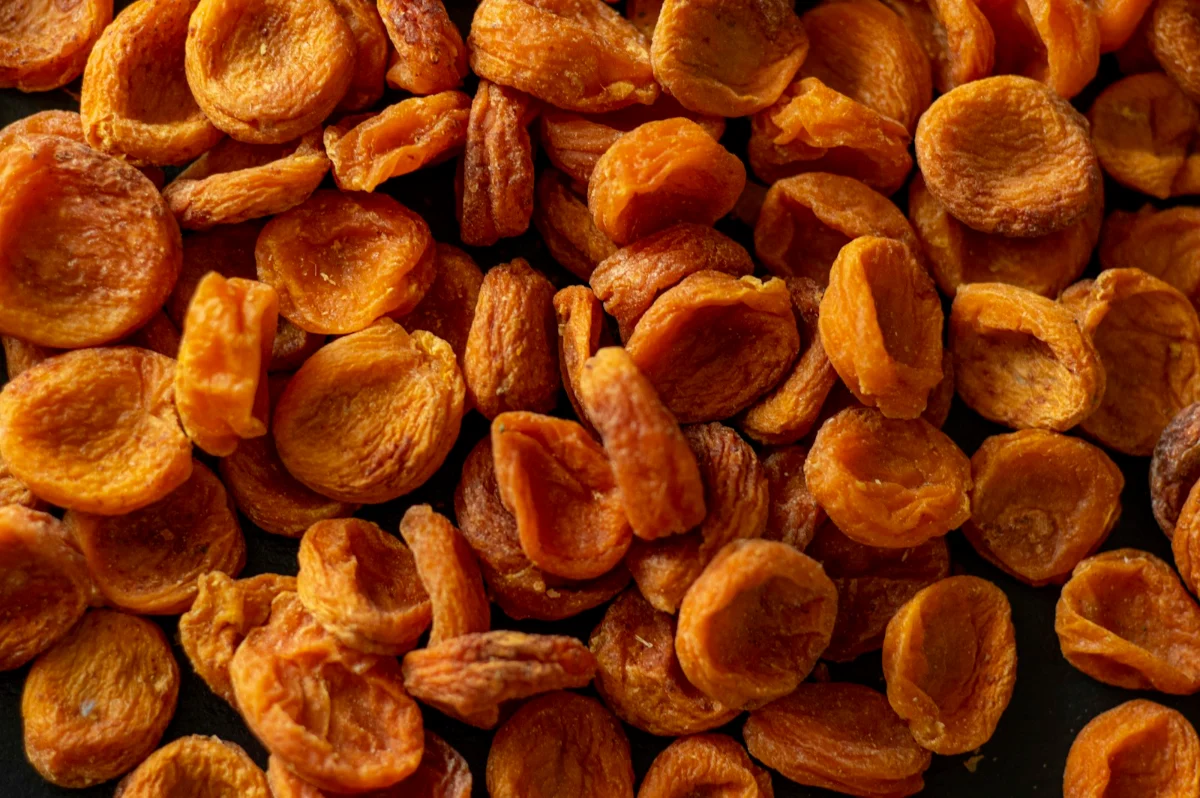
Short answer. How to dry fruit at home: choose ripe, unbruised fruit, wash it, cut it into even halves or slices, and dip light-coloured fruit in lemon juice or an ascorbic acid solution to slow browning. Dry it in a single layer at about 60°C, the temperature US extension guides give for a dehydrator or oven, until the pieces are leathery and a squeezed, cooled handful leaves no moisture on your hand. Slices can be ready in about 6 hours; apricot and peach halves take 24 hours or more. Condition the fruit in loosely filled, sealed jars for 7 to 10 days, then store it airtight somewhere cool and dark. Sun-drying works only in hot, dry weather, and sun-dried fruit should be pasteurised before it is packed.
This guide is about fruit. Biltong and rusks in a dehydrator raise different safety and texture questions, and we’ll cover them in separate articles.
On this page
- When is fruit-drying season in South Africa?
- How to dry fruit at home: dehydrator, oven or sun?
- How to prepare fruit for drying
- How do you stop dried fruit going brown?
- Drying times for apricots, peaches, plums, mangoes and more
- How to tell when dried fruit is ready
- Conditioning, packing and storing dried fruit
- How to make fruit leather from soft or overripe fruit
- What can go wrong, and how to keep dried fruit safe
- Frequently asked questions
When is fruit-drying season in South Africa?
Stone fruit is a summer crop here. Hortgro, the deciduous fruit industry body, publishes local market sales charts for the 2019/20 season that show apricots on the local market from October to February, nectarines from October to March, peaches to April and plums to May (Hortgro). The National Agricultural Marketing Council (NAMC) puts the peach production season between October and March, depending on variety and region (NAMC, 2024). Apricots leave the market first, so buy them for drying early in the summer.
The other fruit worth drying follows close behind:
- Mangoes. NAMC says the season normally begins in November and ends around late March, with Tommy Atkins picked mostly in December and Keitt from February to late April. In 2023/24, 13% of the crop was dried.
- Figs. Grown in the Western Cape (Porterville, Paarl, Napier) and North West. Growers quoted by FreshPlaza harvest Ronde de Bordeaux from about late December to February, and Bourjassotte Noire into late April and May (FreshPlaza, 2017).
- Grapes. For the 2024/25 raisin crop, Raisins South Africa expected the early harvest to start in January, with peak intake at processors in March (Fruitnet).
Drying fruit is an old trade here. Apricots for drying come mainly from the Little Karoo, prunes from Tulbagh, most raisins from the Lower Orange River and currants from around Vredendal (Agribook). Hortgro’s crop figures for 2019/20 show 6,040 tonnes of apricots and 12,018 tonnes of peaches and nectarines going for drying. A Wellington dried-fruit marketer told FreshPlaza in 2025 that the farmers who dry for his company do most of it in the sun, the cheapest way, with apples and peeled peaches dried in tunnels (FreshPlaza, 2025).
How to dry fruit at home: dehydrator, oven or sun?
Colorado State University Extension and the University of Missouri give 60°C as the drying temperature for fruit, and the University of Illinois gives it for food in general (Colorado State; Illinois; Missouri). Illinois notes that higher temperatures tend to cook the food rather than dry it.
In an electric dehydrator
The National Center for Home Food Preservation (NCHFP) at the University of Georgia describes a dehydrator as a heating element, a fan and vents, with a thermostat, built to dry food quickly at about 60°C (NCHFP, dehydrators). Where the fan and element sit at the side (horizontal airflow), it says, all trays get equal heat, and a timer that switches the unit off overnight helps prevent scorching. Colorado State says fruit dries faster in a dehydrator than in a conventional oven.
Arrange the fruit in a single layer, cut side up (Colorado State), and if possible turn large pieces every 3 to 4 hours.
In the oven
Check that your oven can hold 60°C (Illinois); an oven thermometer will tell you. Illinois suggests keeping the door slightly open with a fan blowing at the oven; NCHFP’s oven method for mango leather opens the door 5 to 15 cm and checks the temperature regularly (NCHFP, mango leather). Clemson Cooperative Extension says drying in a conventional oven can take up to twice as long because of uneven air circulation (Clemson). Fruit scorches easily towards the end, so Colorado State turns the oven off when the fruit is nearly done and leaves the door wide open for another hour.
In the sun
NCHFP says fruit can be dried outdoors because its high sugar and acid make it safe when conditions are right, but it doesn’t recommend outdoor drying for vegetables or meat (NCHFP, sun drying). It needs:
- a temperature of at least 29°C (hotter is better), humidity below 60%, and ideally hot, dry, breezy days. Drying takes several days; Clemson gives 2 to 6;
- racks raised on blocks so air moves underneath, with food-safe screens (stainless steel, Teflon-coated fibreglass or plastic), not galvanised mesh, copper or aluminium;
- a second screen or cheesecloth over the top to keep birds and insects off;
- covering the fruit or bringing it under shelter at night, because cool night air brings moisture back.
A Karoo or Northern Cape summer can meet those conditions. On a humid coast, many summer days won’t. Clemson advises pasteurising fruit dried outdoors before packing it: either freeze it in freezer bags at −18°C or below for at least 48 hours, or heat it in a single layer on a baking tray for 30 minutes in an oven preheated to 71°C.
How to prepare fruit for drying
Colorado State’s advice is to use fresh, fully ripe fruit: overripe fruit can be tough and fibrous, or soft and mushy. Wash it well, and throw out any with decay, bruises or mould. For mangoes, choose firm-ripe fruit (Oregon State); very soft mangoes give dark slices, says Fairchild Tropical Botanic Garden’s mango curator (Fairchild).
Cut pieces to an even size so they finish together. Thinner slices and smaller pieces dry faster than halves or whole fruit (Colorado State). Apricots are halved and stoned but not peeled; peaches and nectarines are usually peeled, halved and stoned, though Clemson treats peeling as optional. Mango cheeks are peeled and cut into slices about 6 mm thick (Oregon State).
Small fruit dried whole, such as seedless grapes, small figs and small plums, has tough skins. Colorado State “cracks” them first: dip the fruit in briskly boiling water for 30 to 60 seconds (1 to 2 minutes for whole plums), then into very cold water, and drain it on towels.
How do you stop dried fruit going brown?
Light-coloured fruit such as apricots, peaches and nectarines darkens once it is cut. Colorado State soaks the cut fruit for 10 minutes in one of these, then drains it:
- Ascorbic acid (vitamin C): 2½ tablespoons (34 g) of crystals in 1 litre of cold water. Writing for US shoppers, Colorado State says pure crystals are usually sold at supermarkets and pharmacies.
- Citric acid: 1 teaspoon (5 g) in 1 litre of cold water.
- Lemon juice: equal parts lemon juice and cold water.
Commercial anti-browning mixtures are less effective than ascorbic acid, according to Colorado State, which also says a pre-treatment helps destroy potentially harmful bacteria during drying.
Why is shop-bought dried fruit so orange?
Often because it has been treated with sulphur dioxide, a sulphite. South Africa’s dried fruit regulations call fruit treated this way before drying “bleached”, and bleached fruit may not be sold as preservative-free (Dried fruit regulations, R653 of 2014). A Wellington dried-fruit marketer told FreshPlaza that sulphur dioxide is used to keep the colour because “people buy with their eyes”; without it, the fruit darkens after about two months, and his company gets very few requests for unsulphured fruit (FreshPlaza, 2025). Home-dried fruit dipped in lemon juice or ascorbic acid will be darker and browner than the bright orange apricots in the shops.
Colorado State advises against burning sulphur at home and says not to use sulphite dips if anyone eating the fruit is sensitive to sulphites, so this guide sticks to lemon juice, citric acid and ascorbic acid.
If you have asthma or a known sulphite sensitivity, check the label on bought dried fruit. Food Standards Australia New Zealand (FSANZ) lists dried fruit among foods that commonly contain sulphites, and says some sulphite-sensitive people, many of whom have asthma, may react with allergy-like symptoms (FSANZ). The Australasian allergy society ASCIA names dried apricots as a source (ASCIA, 2024). On the ingredients list, look for sulphur dioxide or a sulphite, or the additive numbers 220 to 228.
Drying times for apricots, peaches, plums, mangoes and more
Times are for a dehydrator at 60°C unless stated. They depend on piece size, humidity and airflow (Colorado State), so start checking early.
| Fruit | Preparation | Anti-browning dip | Drying time | Ready when |
|---|---|---|---|---|
| Apricots | Halve and stone; don’t peel; lay cut side up | Ascorbic acid or lemon juice | 24–36 hours (halves) | Soft, pliable and leathery, with no moist area in the centre when cut |
| Peaches and nectarines | Ripe but firm; peel (optional), halve and stone, or slice | Ascorbic acid, citric acid or lemon juice | Halves 24–36 hours (Clemson: 36–48); Colorado State gives 6–36 for halves, quarters or slices | Leathery and somewhat pliable |
| Plums | Halve or slice and stone; small plums can stay whole, skins cracked in boiling water for 1–2 minutes | Ascorbic acid for halves and slices | Slices 6–10 hours; halves or whole 24–36 | Pliable and leathery |
| Mangoes | Firm-ripe; peel, cut the cheeks into slices about 6 mm thick | None given | 10–12 hours at 57°C | Pliable, with no soft or moist patches |
| Figs | Fully ripe; leave small figs whole (skins cracked for 30 seconds), halve large ones | Ascorbic acid for cut figs | 6–24 hours | Leathery and pliable |
| Seedless grapes | Remove stems; leave whole, skins cracked in boiling water for 30 seconds, then cold water | None for whole grapes | 12–24 hours | Pliable and leathery, with no moist centre |
Sources: preparation, dips and dryness tests from Colorado State (Kendall and Sofos), except mangoes (Oregon State University Extension, plus Fairchild on ripeness). Other time ranges run from the lowest to the highest figure given by Colorado State, Clemson (HGIC 3084) and the Pacific Northwest extension services’ drying manual (PNW 651); peaches show each guide’s figure because they differ. Peeling peaches optional: Clemson. Fairchild Tropical Botanic Garden gives 8–10 hours at 52–57°C for mango slices 6–13 mm thick. Neither mango source suggests a dip.
How to tell when dried fruit is ready
Test pieces after they have cooled to room temperature: warm fruit feels softer, moister and more pliable than it is (Colorado State). Then:
- Squeeze a handful. If no moisture is left on your hand and the pieces spring apart when you let go, they are dry (Colorado State).
- Cut a few pieces in half. There should be no visible moisture and you shouldn’t be able to squeeze any out (Clemson).
- Fold a piece. It can stay pliable but shouldn’t be sticky or tacky, and it shouldn’t stick to itself when folded (Clemson).
Home-dried fruit should end up leathery rather than crisp, at about 20% moisture (NCHFP, storage).
Conditioning, packing and storing dried fruit
Some pieces always come off the trays wetter than others. Conditioning evens out the moisture and reduces the risk of mould (Clemson):
- Let the fruit cool completely. Warm fruit sweats in a container, and that moisture can let mould grow (NCHFP).
- Pack it loosely into clean, dry glass jars, about two-thirds full (Colorado State), and seal them.
- Leave the jars for 7 to 10 days and shake them every day so the pieces separate (NCHFP, Clemson).
- If condensation forms inside a jar, put the fruit back in the dehydrator, dry it further and condition it again.
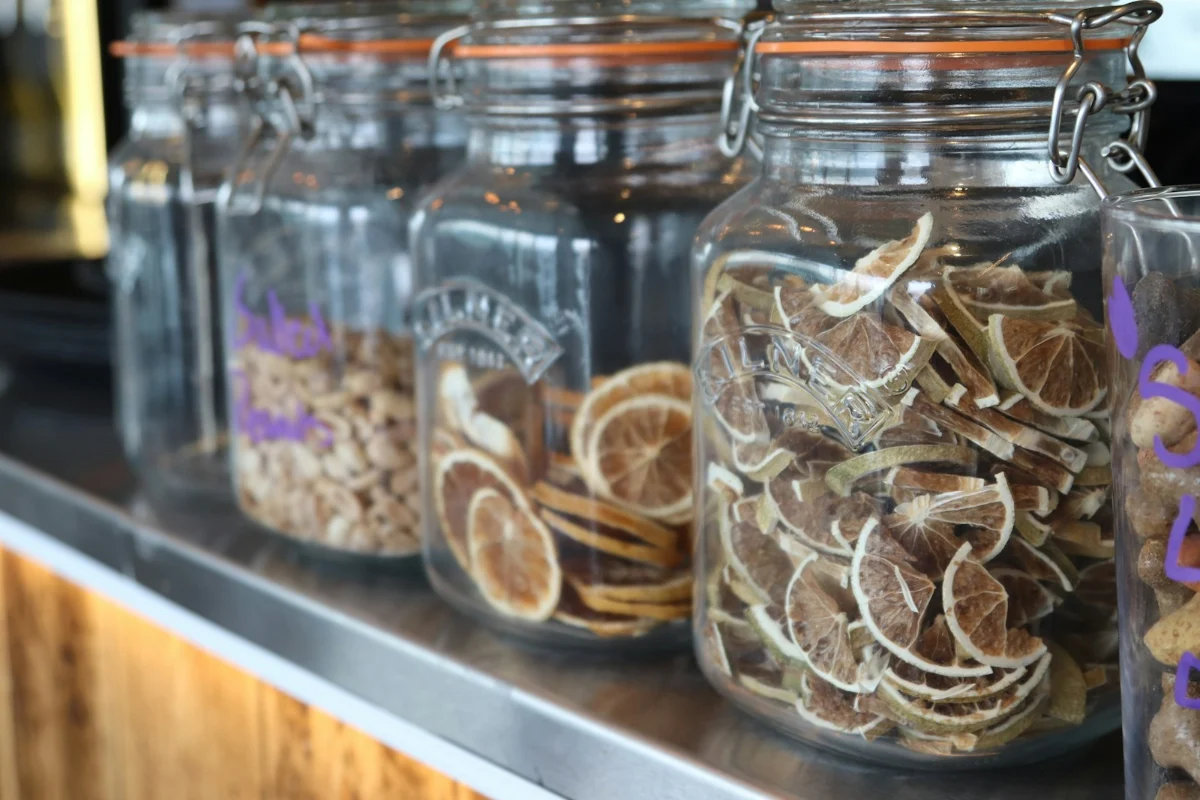
Once conditioned, pack the fruit into clean, dry, insect-proof containers: glass jars, freezer containers with tight lids, freezer bags or vacuum bags. Pack it in amounts you’ll use at one time, because each opening lets in air and moisture (NCHFP).
Store dried fruit somewhere cool, dry and dark. NCHFP gives 4 months to a year: most dried fruit keeps about a year at 16°C and about six months at 27°C. With storage time halving between those temperatures, the fridge or freezer (Colorado State lists both) suits fruit you want to keep for months through a hot South African summer. Check jars now and then; fruit that has picked up moisture but isn’t spoiled should be eaten soon or dried again (NCHFP).
How to make fruit leather from soft or overripe fruit
Fruit too soft to slice makes good fruit leather. NCHFP’s method (fruit leathers):
- Use ripe or slightly overripe fruit. Wash it, remove peel, stones and stems, and purée about 475 ml (2 US cups) for each 33 × 38 cm sheet.
- For light-coloured fruit, add 2 teaspoons of lemon juice or ⅛ teaspoon of ascorbic acid per 475 ml of purée. Sweetening with honey or sugar is optional.
- Spread it about 3 mm thick on a dehydrator’s solid sheet or a lined baking tray (plastic wrap in NCHFP’s method, baking paper in Missouri’s; not waxed paper or foil), keeping it back from the edges.
- Dry at 60°C: about 6 to 8 hours in a dehydrator, up to 18 in an oven, or 1 to 2 days in the sun.
- It is done when touching the centre leaves no dent. Peel it off while warm, roll it, cool it and wrap it.
It keeps about a month at room temperature, or up to a year tightly wrapped in the freezer. NCHFP’s mango leather, spread 6 mm thick, takes about 10 hours in a dehydrator (NCHFP, mango leather).
What can go wrong, and how to keep dried fruit safe
- Under-dried fruit goes mouldy. Colorado State says to dry fruit enough to prevent microbial growth and spoilage. Test cooled pieces, and don’t skip conditioning; it shows you which batches need more time.
- Fruit that is too hot cooks or scorches. Keep to about 60°C (Illinois), and watch the last hours closely, when fruit scorches most easily (Colorado State).
- Fruit picks up moisture in storage. Warm fruit, damp jars and a big jar opened often all let moisture in (NCHFP).
Throw out dried fruit that is mouldy or smells off (NCHFP, Colorado State). The Pacific Northwest manual says to discard the whole package if mould appears, rather than picking out the bad pieces.
Frequently asked questions
How long does it take to dry fruit in a dehydrator?
At 60°C, from about 6 hours for thin slices to 24 to 36 hours for apricot and peach halves (Clemson allows up to 48 for peaches). Oregon State gives 10 to 12 hours at 57°C for mango slices about 6 mm thick. See the table above for each fruit.
How do you dry fruit without a dehydrator?
In an oven that holds about 60°C, with the door slightly open and a fan blowing at it (Illinois; NCHFP’s mango-leather method opens it 5 to 15 cm), or in the sun when it is at least 29°C with humidity below 60%. Oven drying can take up to twice as long (Clemson), and sun-dried fruit should be pasteurised before packing.
Can you dry fruit in an air fryer?
Only if it can hold a low temperature, about 60°C, for many hours; some models have a dehydrate setting for this. None of the extension guides used here test air fryers, so follow the maker’s instructions, keep the fruit in a single layer and use the same dryness test.
Why do home-dried apricots turn brown when shop ones stay orange?
Shop-bought dried apricots are often treated with sulphur dioxide, which holds the colour. Lemon juice and ascorbic acid slow browning but don’t stop it, so home-dried apricots end up darker. The colour doesn’t tell you whether they are properly dry; the squeeze test does.
Do you need to peel fruit before drying it?
Not apricots, figs or grapes, but crack the skins of whole grapes and small plums in boiling water. Peaches and nectarines are usually peeled (Clemson says optionally), and mangoes always.
How long does home-dried fruit last?
Four months to a year, airtight, somewhere cool, dark and dry: about a year at 16°C and six months at 27°C (NCHFP). Fruit leather keeps about a month at room temperature, or a year frozen.
Can you sun-dry fruit in South Africa?
Yes, in the right weather: at least 29°C and humidity below 60% for several days (NCHFP). Use food-safe screens, cover the fruit, bring it in at night and pasteurise it before packing.
Dehydrators from EcoHub
- Ezidri Ultra FD1000 5-tray dehydrator: R6,295 incl VAT. Five trays, one mesh sheet and one solid sheet; expandable to 30 trays; digital temperature control from 30 to 70°C.
- Ezidri Ultra 10-tray dehydrator: R9,199 incl VAT. Ten trays, one mesh sheet and one solid sheet; expandable to 30 trays; temperature from 30 to 70°C.
- Kuto Dehydrator: R4,499 incl VAT. Six square 33 × 30 cm trays; temperature from 35 to 70°C in 5-degree steps; digital timer up to 19.5 hours.
Prices correct at November 2026, incl VAT.
Sources
All opened and checked on 3 Nov 2026 unless noted.
- Hortgro. “Stone fruit” (industry statistics, local market sales and dried production, 2019/20). https://www.hortgro.co.za/our-industry/stone-fruit/
- National Agricultural Marketing Council. SA Fruit Trade Flow Report, Issue 56, December 2024 (mango and peach sections). https://www.namc.co.za/wp-content/uploads/2024/11/SA-Fruit-Trade-Flow-Report-Issue-56-December-2024-submission.pdf
- FreshPlaza. “Fig exports from South Africa steadily on the rise,” 23 February 2017. https://www.freshplaza.com/article/2171365/fig-exports-from-south-africa-steadily-on-the-rise/
- Fruitnet. “South African raisin crop set to exceed 100,000 tonnes for first time” (Raisins SA, 2024/25 season), undated online. https://fruitnet.com/fresh-produce-journal/south-african-raisin-crop-set-to-exceed-100000-tonnes-for-first-time/264244.article
- Agribook Digital. “Dried fruit.” https://www.agribook.co.za/dried-fruit
- Jansen C. “I believe South African dried fruit is unrivalled,” FreshPlaza, 20 June 2025 (De Wet Burger, Kambrosig, Wellington). https://www.freshplaza.com/article/9738227/i-believe-south-african-dried-fruit-is-unrivalled
- National Center for Home Food Preservation. “Food Dehydrators,” from So Easy to Preserve, 6th ed., 2014 (Andress EL, Harrison JA). https://nchfp.uga.edu/how/dry/drying-general/food-dehydrators/
- National Center for Home Food Preservation. “Sun Drying,” from So Easy to Preserve, 6th ed., 2014. https://nchfp.uga.edu/how/dry/drying-general/sun-drying/
- National Center for Home Food Preservation. “Packaging and Storing Dried Foods,” from So Easy to Preserve, 6th ed., 2014 (reviewed 2020). https://nchfp.uga.edu/how/dry/drying-general/packaging-and-storing-dried-foods/
- National Center for Home Food Preservation. “Fruit Leathers,” from So Easy to Preserve, 6th ed., 2014 (reviewed 2020). https://nchfp.uga.edu/how/dry/recipes/fruit-leathers/
- Andress EL. “Mango Leather,” National Center for Home Food Preservation, January 2004. https://nchfp.uga.edu/how/dry/recipes/mango-leather/
- Kendall P, Sofos J. “Drying Fruits,” Colorado State University Extension, 1994, reviewed August 2025. https://extension.colostate.edu/resource/drying-fruits/
- Schmutz P, Hoyle EH. Drying Fruits, HGIC 3084, Clemson Cooperative Extension, updated June 2024. https://hgic.clemson.edu/factsheet/drying-fruits/
- Mellendorf C. Fill Your Pantry: Drying Foods at Home, University of Illinois Extension, July 2021. https://extension.illinois.edu/sites/default/files/drying_fill_your_pantry_final_2021.08.05_ls.pdf
- Mills-Gray S, Willenberg B. How to Dehydrate Foods, GH1563, University of Missouri Extension. https://extension.missouri.edu/media/wysiwyg/Extensiondata/Pub/pdf/hesguide/foodnut/gh1563.pdf
- Oehler N. “Preserving fruits: Mangoes,” SP 50-1006, Oregon State University Extension Service, March 2020, reviewed 2024. https://extension.oregonstate.edu/food/preservation/preserving-fruits-mangoes
- Ledesma N. “Making Mango ‘Candy’: How to Make Dried Mango Slices or Mango Leather,” Fairchild Tropical Botanic Garden (first published in Tropical Garden, Summer 2015). https://fairchildgarden.org/visit/making-mango-candy-how-to-make-dried-mango-slices-or-mango-leather/
- Lanting R, Wittman G, Gillespie DR. Drying Project Manual, PNW 651, University of Idaho, Oregon State University and Washington State University Extension, September 2013. https://objects.lib.uidaho.edu/uiext/uiext32185.pdf
- Australasian Society of Clinical Immunology and Allergy. Sulfite Sensitivity Frequently Asked Questions, updated August 2024. https://www.allergy.org.au/images/pc/ASCIA_PC_Sulfite_Sensitivity_FAQ_2024.pdf
- Food Standards Australia New Zealand. “Sulphites,” updated 26 November 2025. https://www.foodstandards.gov.au/consumer/additives/sulphite
- Department of Agriculture, Forestry and Fisheries. Regulations relating to the quality, packing and marking of dried fruit intended for sale in the Republic of South Africa, No. R. 653, Government Gazette 37949, 29 August 2014. https://www.gov.za/sites/default/files/gcis_document/201409/37949rg10254gon653.pdf
- EcoHub. Ezidri Ultra FD1000 5-tray product page (price and specification). https://www.ecohub.co.za/shop/dehydrators/ezidri-ultra-dehydrator/
- EcoHub. Ezidri Ultra 10-tray product page (price and specification). https://www.ecohub.co.za/shop/dehydrators/ezidri-ultra-dehydrator-10/
- EcoHub. Kuto Dehydrator product page (price and specification). https://www.ecohub.co.za/shop/dehydrators/kuto-standard-dehydrator/