

Short answer. On cold press vs centrifugal juicers, the studies agree on one thing: a slow, cold-press juicer gets more juice out of the same produce. In a 2024 study it extracted 92% from pineapple against 47% for a centrifugal juicer, and its juice was smoother and did not separate. What the studies do not establish is that cold-pressed juice is more nutritious. That 2024 study found no meaningful difference in antioxidant activity and similar phenolic content, and the two Korean studies that favour slow juicers are small and partly industry-linked. Choose a cold press juicer for more juice per kilo, less foam, quieter running and much better results with leafy greens, not for a promise of extra nutrients.
On this page
- How does a centrifugal juicer work?
- How does a cold press juicer work?
- Cold press vs centrifugal: what the studies found
- More juice per kilo
- Foam, separation and taste
- Heat and noise
- Preparation, cleaning and price
- Is juice as good as eating whole fruit and vegetables?
- Which should you buy?
- Frequently asked questions
How does a centrifugal juicer work?
A centrifugal juicer drops produce onto a flat cutting disc that spins very fast inside a mesh basket. The disc shreds the produce and the spinning basket flings the juice out through the mesh, while the pulp collects in a separate container or stays in the basket. In one of the studies below, the centrifugal juicer’s blade disc turned at 8,000 to 12,000 rpm. Centrifugals are quick, usually have a wide chute and are often cheaper to buy, which is why they are still common.
How does a cold press juicer work?
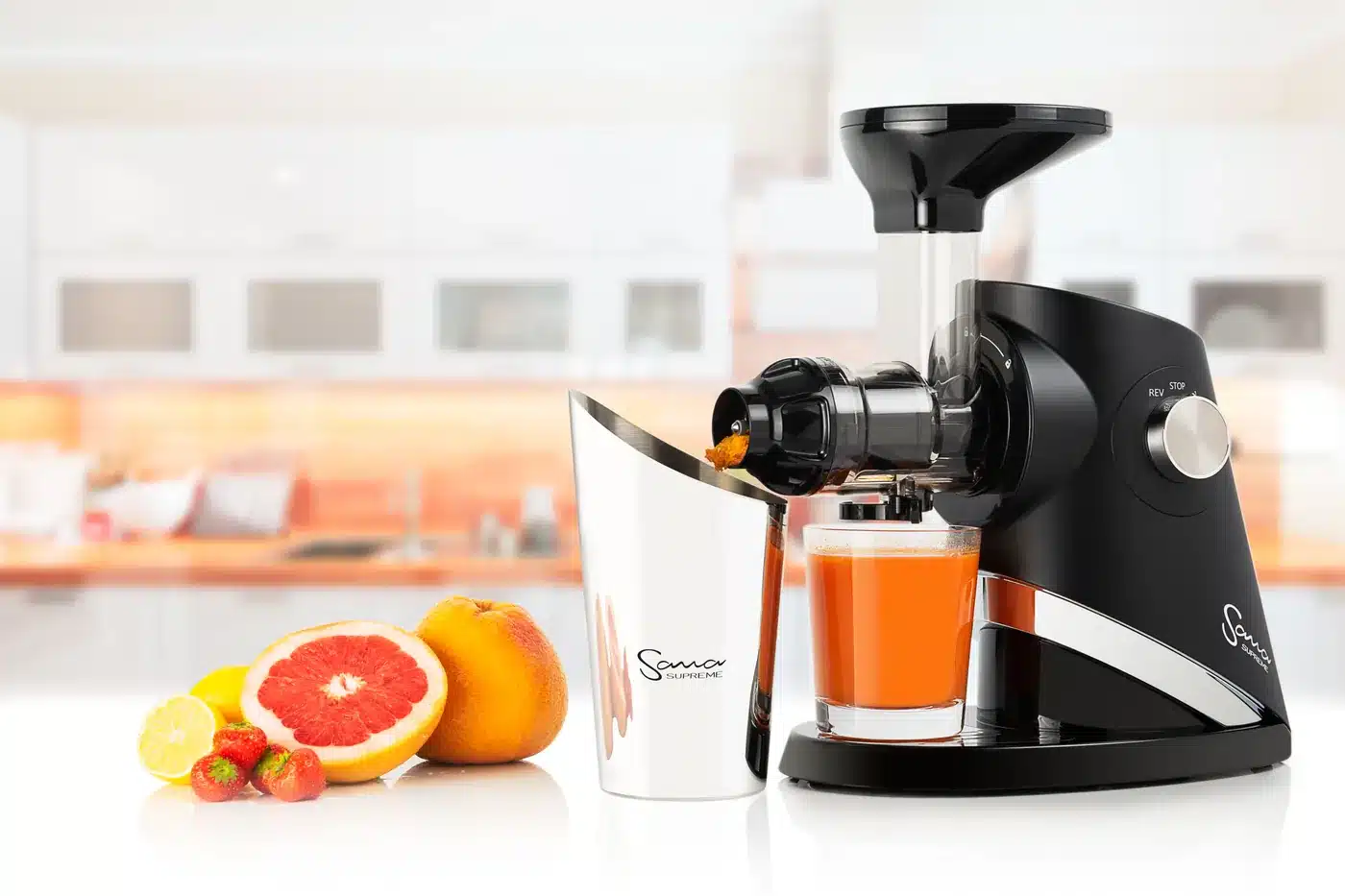
A cold press juicer, also called a slow or masticating juicer, uses a screw-shaped auger instead of a blade. The auger turns slowly, crushes the produce and presses it against a fine screen; the juice runs through and the dry pulp is pushed out separately. The slow juicer in the same study ran at roughly 40 to 80 rpm, and the household models EcoHub stocks turn at between 40 and 120 rpm. “Cold press” describes the pressing action rather than a measured temperature.
Cold press juicers come in two layouts, horizontal and vertical, which suit different produce. That choice is covered in horizontal vs vertical slow juicers.
Cold press vs centrifugal: what the studies found
Here are three published studies that compare a household slow juicer with a household centrifugal juicer on the same produce.
| Study | Produce | Juice yield (slow vs centrifugal) | Nutrients and antioxidants | Notes |
|---|---|---|---|---|
| Baykus and Unluturk, Food Science and Engineering, 2024 | Pineapple, green apple and kiwifruit blend | Pineapple: 92% vs 47% | Total phenolics similar (867 vs 922 mg/L, slightly higher in the centrifugal juice); no significant difference in antioxidant activity | Cold-pressed juice was cloudier and did not separate; it was also slightly darker |
| Kim and colleagues, Food Science and Biotechnology, 2015 | Tomato | Higher in the slow juicer (figures not given in the abstract) | Polyphenols, vitamin C, lycopene and antioxidant activity higher in the slow juicer’s juice | Centrifugal juice separated into two layers with many fine bubbles; tasters preferred the slow juicer’s juice |
| Kim and colleagues, Food Science and Biotechnology, 2017 | Grape (one variety) | 79.1% vs 45.0% | Polyphenols 326.8 vs 90.3 mg per 100 ml; anthocyanins and several antioxidant measures higher in the slow juicer’s juice | One grape variety from one market; the lead author is listed at Hurom’s research centre and the slow juicer tested was a Hurom |
What the three studies agree on
Yield. In every study the slow juicer produced more juice from the same weight of produce. In the pineapple test it was nearly twice as much (92% against 47%), and in the grape test 79.1% against 45.0%. That is the most consistent finding, and the one that matters every time you buy produce: more juice per kilo.
Texture. The centrifugal juices separated into layers, and the tomato juice from the centrifugal machine carried many fine bubbles. The cold-pressed juices stayed even and cloudy.
Where they disagree
Nutrients. The two Korean studies found more polyphenols and antioxidant activity in slow-juicer juice, in the grape study by a wide margin. The 2024 study, from a different research group using a fruit blend, found phenolic content slightly higher in the centrifugal juice and no significant difference in antioxidant activity. Its authors say more studies are needed.
Context matters too. Each study tested one slow juicer against one centrifugal model, on one or two fruits, under laboratory conditions. The grape study lists its lead author at the research centre of Hurom, the Korean slow-juicer maker, which also manufactures the Sana juicers EcoHub sells. Its authors declared no conflict of interest, and the results may well be sound, but it is a reason not to lean on them alone.
The fair reading: cold pressing reliably gives more juice and a smoother texture; whether the juice carries more nutrients per glass depends on the produce and is not settled.
More juice per kilo
Yield is where the difference shows in your shopping. If a slow juicer extracts close to twice as much from pineapple, you need less fruit for the same jug, and the pulp that comes out is noticeably drier. The exact gain varies with the produce and the machine, so treat the study figures as an indication, not a promise.
The gap is widest with leafy greens and wheatgrass. A spinning basket throws light leaves around rather than pressing them, so centrifugal juicers do comparatively poorly with kale, spinach, herbs and wheatgrass, while a slow auger grips and presses them. Independent reviewers at UK Juicers reach the same view.
Foam, separation and taste
A blade spinning at thousands of revolutions a minute whips air into the juice. That shows up as a foam layer on top and, in the studies above, as juice that separates into layers. Cold-pressed juice comes out denser and more even, and in the tomato study a tasting panel preferred it. One caveat from the 2024 study: the cold-pressed juice was slightly darker, so a smoother texture doesn’t mean it looks fresher in the glass.
Heat and noise
You will often read that centrifugal juicers “kill enzymes” with heat. None of the three studies measured juice temperature or enzymes, so we don’t repeat the claim. What can be said is that a slow auger works the produce gently, with less air whipped in and less heat from friction than a fast-spinning blade.
Noise is easier to judge in your own kitchen. A centrifugal motor running at high speed is loud for the minute or two it takes to make juice. A slow juicer’s motor turns at a fraction of that speed and is much quieter, which matters if you juice early while the household is asleep.
Preparation, cleaning and price
- Preparation. Centrifugals have traditionally been faster to feed, with wide chutes for whole fruit. Many slow juicers now have wide chutes or hands-free hoppers too, so the gap is smaller than it was.
- Cleaning. A centrifugal’s fine mesh basket needs a brush to clear. A slow juicer’s screen does too, and both are easiest to clean straight after use, before the pulp dries.
- Price. Household centrifugal juicers are generally cheaper to buy. Slow juicers cost more, and the extra yield offsets some of that over time.
- Speed at volume. Where hundreds of glasses a day matter more than the last drop from each orange, as in some juice bars, a commercial centrifugal such as the Zumex Multifruit is built for that throughput.
Is juice as good as eating whole fruit and vegetables?
Whichever juicer you choose, juice is not a replacement for eating produce whole. The Mayo Clinic’s view is that juicing is no healthier than eating whole fruits and vegetables: juice keeps most of the vitamins and minerals but loses most of the fibre, which helps digestion and keeps you full. The NHS counts 150 ml of fruit or vegetable juice as one of your five a day, and only once however much you drink, because juicing releases the sugars in fruit.
That is why many regular juicers keep their recipes vegetable-led, with fruit for balance. If you have diabetes, kidney disease or another health condition, or take regular medication, check with your doctor before adding fresh juice to your routine.
Which should you buy?
- Choose a cold press juicer if you want more juice per kilo, little foam, a quieter machine, and you plan to juice greens, celery, wheatgrass or ginger. Then decide between a horizontal and a vertical layout using horizontal vs vertical slow juicers. If greens are the reason, a horizontal such as the Sana 707 or Sana 727 Supreme is the natural fit; for fruit-led family batches, a hands-free model such as the Sana 878.
- A centrifugal can suit you if you only juice hard fruit such as apples and carrots, want the lowest purchase price, and don’t mind foam or noise.
- Don’t buy either on a nutrition promise. “More nutritious” is not established by the evidence so far; more juice, better texture and better handling of greens are.
Our broader guide, how to choose a cold-press juicer in South Africa, covers commercial machines too, and the full range is under juicers.
Frequently asked questions
Is cold-pressed juice more nutritious than centrifugal juice?
It hasn’t been shown reliably. Two small Korean studies found more polyphenols and antioxidant activity in juice from a slow juicer, but a 2024 study on a pineapple, apple and kiwi blend found similar phenolic content and no significant difference in antioxidant activity. What the studies agree on is that a slow juicer gives more juice from the same produce.
Do centrifugal juicers destroy enzymes?
The studies comparing the two kinds of juicer did not measure enzymes or juice temperature, so there is no good evidence for the claim either way. A slow juicer does work more gently, with less air whipped into the juice and less heat from friction.
How much more juice does a cold press juicer give?
It depends on the produce and the machine. In one 2024 study a cold press juicer extracted 92% of the juice from pineapple against 47% for a centrifugal juicer. In a 2017 study on grapes the figures were 79.1% and 45.0%. The difference tends to be largest with leafy greens and wheatgrass.
Why does centrifugal juice foam and separate?
The cutting disc spins at thousands of revolutions a minute and whips air into the juice, which forms foam. In the studies, juice from centrifugal machines separated into layers, while cold-pressed juice stayed even and cloudy.
Is a masticating juicer the same as a cold press juicer?
Yes. Masticating, slow and cold press juicer are names for the same idea: an auger turning slowly that crushes and presses produce against a screen, rather than a fast-spinning blade that shreds it.
Is fresh juice as healthy as eating whole fruit and vegetables?
No. Juice keeps most of the vitamins and minerals but loses most of the fibre, and the Mayo Clinic says juicing is no healthier than eating produce whole. The NHS counts 150 ml of juice as one of your five a day, and only once a day.
Sources
- Baykus G, Unluturk S. Cold pressed vs. centrifugal juice: comparison in terms of the juice yield, physicochemical and phytochemical properties. Food Science and Engineering, 2024; 5(1): 145–54. wiserpub.com
- Kim MJ, Kim JI, Kang MJ and others. Quality evaluation of fresh tomato juices prepared using high-speed centrifugal and low-speed masticating household juicers. Food Science and Biotechnology, 2015; 24: 61–66. link.springer.com
- Kim MJ, Jun JG, Park SY and others. Antioxidant activities of fresh grape juices prepared using various household processing methods. Food Science and Biotechnology, 2017; 26(4): 861–869. pmc.ncbi.nlm.nih.gov
- Juicing: is it healthier than eating whole fruits and vegetables?, Mayo Clinic expert answer. mayoclinic.org
- 5 A Day: what counts?, NHS. nhs.uk
- Which is the best juicer?, UK Juicers: juicer types compared by ingredient. ukjuicers.com