

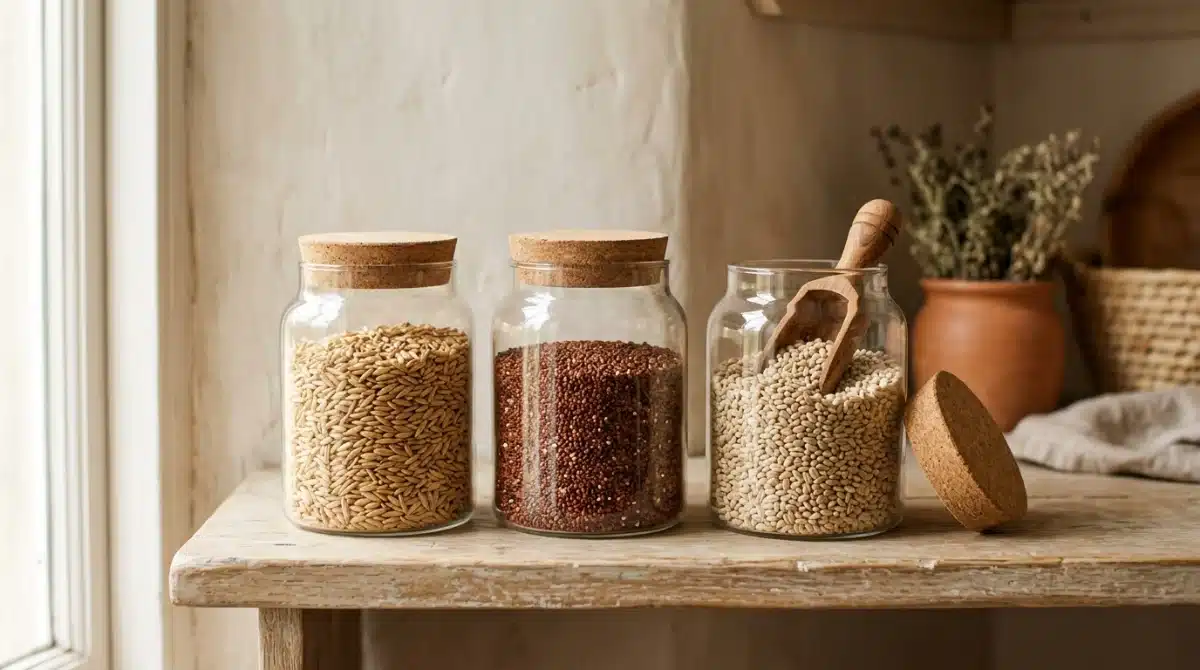
One kilogram of wheat berries makes one kilogram of wholemeal flour. There is no loss, because nothing is removed: you are milling the entire grain. That one-to-one rule is the only conversion you really need, and it makes planning simple: 500 g of flour per loaf, so 1 kg of grain is two loaves, and a 10 kg bag is twenty.
Where people come unstuck is volume. A cup of wheat berries is not a cup of flour. It is roughly a cup and a half, because whole grain is dense and flour is fluffy. Get those two facts straight and you can plan a month of baking on the back of an envelope.
This is the reference page for all of it: weight and volume conversions, flour needed per bake, how long the milling itself takes, what size bag to order, how much space it takes up, and what a loaf actually costs in rands.
On this page
- How much flour does 1 kg of wheat make?
- How many cups of flour do I get from a cup of wheat berries?
- How much flour does one loaf need?
- How much grain does a household get through?
- How long does it actually take to mill?
- What size bag should I buy?
- How much space does the grain take up?
- What does a loaf of fresh-milled bread cost in South Africa?
- What if I sift the flour?
- Should I mill ahead or mill as I go?
- How do I scale a recipe up or down?
- The numbers on one page
- Frequently asked questions
- Ready to start milling?
How much flour does 1 kg of wheat make?
One kilogram, near enough exactly.
A stone mill grinds the whole berry, so bran, germ and endosperm all end up in the bowl. Nothing is sifted out and nothing is discarded, so you get 100% extraction. Commercial white flour is around 72–75% extraction, which is why a supermarket mill needs about 1.4 kg of wheat to produce a kilogram of white flour. You don’t.
Two small caveats:
- First run through a new mill: expect to lose 10–20 g as flour dust coats the grinding chamber and the chute. It stays there permanently. From the second batch onwards, what goes in comes out.
- If you sift: then you are removing something, and the one-to-one rule stops applying. There is a full section on sifting further down.
| Grain in | Wholemeal flour out | Loaves (at 500 g flour each) |
|---|---|---|
| 250 g | 250 g | ½ |
| 500 g | 500 g | 1 |
| 1 kg | 1 kg | 2 |
| 2 kg | 2 kg | 4 |
| 5 kg | 5 kg | 10 |
| 10 kg | 10 kg | 20 |
| 25 kg | 25 kg | 50 |
How many cups of flour do I get from a cup of wheat berries?
About one and a half.
A cup of hard wheat berries weighs roughly 190 g. A cup of freshly milled wholemeal flour, spooned in and levelled rather than packed, weighs roughly 130 g. Same 190 g of material, now taking up half again as much room.
1 cup of wheat berries → 1½ cups of flour. That is the rule of thumb, and it holds well enough for wheat, khorasan and spelt.
It does not hold for every grain, because the berries themselves differ in density. Rye and maize are lighter per cup than wheat; oat groats are lighter again.
| Grain | 1 cup of berries weighs | → cups of flour | 1 kg = this many cups of berries |
|---|---|---|---|
| Hard wheat (red or white) | 190 g | 1.45 | 5¼ |
| Khorasan | 190 g | 1.45 | 5¼ |
| Spelt | 180 g | 1.4 | 5½ |
| Rye | 175 g | 1.35 | 5¾ |
| Maize (mielies) | 170 g | 1.3 | 5¾ |
| Oat groats | 160 g | 1.25 | 6¼ |
Better still: stop using cups. Buy a R150 digital scale and weigh everything. Fresh-milled flour is especially unreliable by volume, because how compressed it is depends on how recently it came off the stones, how fine you milled, and whether it has settled in the bowl. The same cup can vary by 15 g, which is 3% of a loaf’s flour. Bakers weigh for a reason, and with fresh-milled flour the reason is stronger.
If you are working from an old recipe written in cups, convert it once, write the grams in the margin, and never do it again.
How much flour does one loaf need?
500 g. That is the number to anchor everything to: a standard round hearth loaf, or a 1 kg (2 lb) tin loaf, both come out of about 500 g of flour and land at 750–850 g baked once the water has driven off.
Here is what everything else costs you in flour:
| What you’re baking | Flour needed | Grain needed |
|---|---|---|
| One hearth loaf (boule or bâtard) | 500 g | 500 g |
| One sandwich loaf, 1 kg / 2 lb tin | 500 g | 500 g |
| 12 dinner rolls | 500 g | 500 g |
| 2 × 30 cm pizza bases | 500 g | 500 g |
| Pasta for 4 | 400 g | 400 g |
| 12 muffins | 300 g | 300 g |
| 12 × 20 cm tortillas | 300 g | 300 g |
| Pancakes or flapjacks for 4 | 250 g | 250 g |
| One banana bread | 250 g | 250 g |
| Crumpets for 4 | 250 g | 250 g |
| One large batch of wholewheat beskuit | 1 kg | 1 kg |
| Sourdough starter, weekly feeding | 100–200 g | 100–200 g |
Don’t forget the starter. A sourdough starter fed twice a week on fresh-milled flour eats 400–800 g a month, about a loaf’s worth. It’s the line item people leave out of their first calculation.
How much grain does a household get through?
Work it out from loaves per week, then add roughly 30% for everything that isn’t bread: pancakes on Saturday, muffins for lunchboxes, a pizza night, starter feeds.
| Baking rate | Per week | Per month | Per year |
|---|---|---|---|
| 1 loaf a week | 500 g | 2.2 kg | 26 kg |
| 2 loaves a week | 1 kg | 4.3 kg | 52 kg |
| 3 loaves a week | 1.5 kg | 6.5 kg | 78 kg |
| 4 loaves a week | 2 kg | 8.7 kg | 104 kg |
| 2 loaves + weekend baking | ~1.3 kg | ~5.6 kg | ~68 kg |
A family of four that has stopped buying bread altogether lands somewhere between 60 and 90 kg of grain a year. That is three or four 25 kg bags. It sounds enormous written down, but it works out at 5 to 7.5 kg a month.
How long does it actually take to mill?
People rarely ask this before buying, and often ask it in week two. The answer depends on which mill you have, and the difference between models is straightforward arithmetic.
The Sana Grain Mill (360 W) mills about 100 g a minute on a fine setting. The Sana Grain Mill MAX (600 W) does about 200 g a minute, double the throughput, which is the entire point of the bigger motor. If you are still choosing between mill types, we compare stone, impact and steel burr mills separately.
| Flour needed | 360 W | MAX 600 W |
|---|---|---|
| 250 g (pancakes) | 2½ min | 1¼ min |
| 500 g (one loaf) | 5 min | 2½ min |
| 850 g (one full hopper, 360 W) | 8½ min | 4¼ min |
| 1 kg (two loaves) | 10 min | 5 min |
| 1.2 kg (one full hopper, MAX) | 12 min | 6 min |
| 2 kg (a week’s baking) | 20 min | 10 min |
| 5 kg | 50 min | 25 min |
| 10 kg | 1 hr 40 min | 50 min |
Two practical notes that matter more than the raw figures:
The hopper is your real batch size. The 360 W holds 850 g of grain, the MAX holds 1,200 g. One hopper-load is one loaf plus a tray of rolls, or two loaves on the MAX. If you routinely want more than that in one sitting you will be standing at the mill refilling, and that is the real argument for the bigger machine: not the minutes saved, but not having to hover.
Coarse is faster than fine. These figures are for a fine bread-flour setting. Open the stones up for a coarse mieliemeal or a cracked-grain porridge and throughput climbs substantially. Set them to their finest for cake or pastry flour and it drops. If the motor starts to labour on a very fine setting, mill in two passes, once coarse and then again fine. It is quicker overall and keeps the flour cooler, which matters for the germ oils.
You do not need to stand there. Load the hopper, switch on, come back when it goes quiet.
What size bag should I buy?
Whole grain keeps for years in the right container, so the only real arguments against a big bag are cash up front and floor space. Bulk is meaningfully cheaper per kilogram, and the price break usually arrives at 10 kg and again at 25 kg.
| Bag | Loaves | How long it lasts at 2 loaves/week | Buy this if |
|---|---|---|---|
| 1–2 kg | 2–4 | 2–4 weeks | You’re trying a new grain for the first time |
| 5 kg | 10 | 5 weeks | You’re in your first month and still finding your feet |
| 10 kg | 20 | 10 weeks | This is the sensible default for most households |
| 25 kg | 50 | 6 months | You’ve settled on your grain and you have somewhere to put it |
Start at 5 kg with a grain you haven’t baked with before. Hard red and hard white wheat behave differently, spelt behaves differently again, and finding out you don’t like a grain after buying 25 kg of it is an expensive lesson in a hobby that is otherwise cheap.
Then buy 10 kg of your everyday wheat and 2 kg each of the interesting things. That is the pattern most home millers arrive at after six months: one workhorse grain in quantity, plus small bags of rye, spelt and khorasan to blend in at 10–20%.
Our guide to where to buy grains for home milling in South Africa covers the suppliers, what they stock, and who ships nationally.
How much space does the grain take up?
Wheat has a bulk density of about 780 kg per cubic metre, which in kitchen terms means 1 kg of wheat berries takes up about 1.3 litres.
| Grain | Volume | Container |
|---|---|---|
| 5 kg | 6.4 ℓ | One 10 ℓ bucket, or two large Consol jars |
| 10 kg | 12.8 ℓ | One 20 ℓ bucket, comfortably |
| 15 kg | 19 ℓ | One 20 ℓ bucket, full to the brim |
| 25 kg | 32 ℓ | Two 20 ℓ buckets |
A standard 20 ℓ food-grade bucket holds about 15.5 kg of wheat. So a 25 kg bag needs two buckets, and you will have a third of the second one spare for the next purchase.
Buckets with gasket lids are the cheap, boring, correct answer. They cost R80–R150 each from a packaging supplier, and they keep out the two things that actually ruin stored grain: moisture and weevils. Grain bought in a woven poly bag should not stay in it. Those bags breathe, which is fine in a warehouse and not fine in a Durban pantry in February.
Keep it dark, keep it under 20 °C if you can, and keep it off a concrete floor, which wicks moisture upwards.
What does a loaf of fresh-milled bread cost in South Africa?
The grain is the only ingredient worth counting. At current South African prices, plan on R25–R45 a kilogram for hard wheat berries, with organic and specialty grains at the top of that band and bulk maize well below it.
| Grain price | Grain cost per loaf (500 g) |
|---|---|
| R25/kg | R12.50 |
| R35/kg | R17.50 |
| R45/kg | R22.50 |
Add salt and a few cents of electricity, and an 800 g wholemeal sourdough loaf lands between R14 and R25. A comparable loaf from a good bakery is R55–R90. If you’re replacing bought bread, that gap is how a mill pays for itself: at two loaves a week and a R40 saving per loaf, you’re about R4,100 a year ahead. If you already bake with bagged flour, you only save the difference between berries and flour, which is far smaller. Our guide to grain mill types works through both comparisons.
That is the arithmetic on ingredients only. It says nothing about the value of the time, which is real, or about the flour itself, which is the actual reason people keep doing it. We will cover the full cost case (mill, electricity, time, resale) in a separate piece.
Check current prices with the suppliers directly. Grain pricing in South Africa moves with the harvest and with the rand, and any figure written into a web page goes stale.
What if I sift the flour?
Then the one-to-one rule no longer applies, and you need to buy more grain than you need flour.
Sifting removes bran. How much depends on the mesh:
| Sieve | Bran removed | Grain needed for 500 g of sifted flour |
|---|---|---|
| No. 40 (fine mesh, high-extraction) | 5–7% | 530 g |
| No. 30 (coarser mesh, near-white) | 15–20% | 610 g |
So a high-extraction loaf costs you about 6% more grain, and a near-white loaf about 20% more. Over a 25 kg bag, sifting at No. 30 is the difference between 50 loaves and 41.
The bran you take out is not waste. It goes into porridge, muffins, crumpets or the compost, and it’s one of the most nutritious parts of what you just milled. There is a case for sifting (it oxygenates the flour and improves water absorption, and it is how you get a light crumb from whole grain) and a case against. Either way, budget the grain for it.
Should I mill ahead or mill as I go?
Mill as you go, and mill only what the recipe needs.
Mill as you go. Fresh-milled flour still has the germ in it, and its oils begin to oxidise once exposed to air, so whole berries keep for years while milled flour keeps for weeks.
The practical rhythm most people settle into:
- Mill for the bake in front of you. Five minutes for a loaf is not the bottleneck in a process that takes eighteen hours.
- If you must mill ahead, refrigerate or freeze it, in a sealed container, and use it within a month. Cold slows the oxidation considerably.
- Don’t mill a month of flour in one go to save time. You are trading the thing you bought the mill for.
There is one possible exception: a short rest does seem to improve handling in some doughs, though the case is much stronger for white flour than for whole grain. We go through the evidence on both sides separately.
How do I scale a recipe up or down?
Work in baker’s percentages and the arithmetic stops being annoying.
Set the total flour at 100%. Every other ingredient is expressed as a percentage of that flour weight. A typical fresh-milled loaf:
| Ingredient | Baker’s % | For 500 g flour | For 1 kg flour |
|---|---|---|---|
| Flour | 100% | 500 g | 1,000 g |
| Water | 85% | 425 g | 850 g |
| Starter | 20% | 100 g | 200 g |
| Salt | 2% | 10 g | 20 g |
To scale, pick your flour weight and multiply. To go from one loaf to three, mill 1.5 kg instead of 500 g and multiply everything by three. Nothing else changes: not the hydration, not the timings, not the temperature.
Two things that do not scale linearly, and catch people out:
- Fermentation time stays roughly the same. A triple batch does not take three times as long to ferment. It may even move slightly faster, because a larger mass of dough holds its own warmth.
- Baking time changes with loaf size, not batch size. Three 500 g loaves bake in the same time as one. One 1.5 kg loaf needs 15–20 minutes longer and a lower oven for the second half.
Note the 85% hydration in that table. Fresh-milled whole grain wants far more water than commercial white flour (85–90% against 70–80%) because the bran absorbs so much of it. If you are converting a recipe written for shop flour, that is the number to change first.
The numbers on one page
- 1 kg grain = 1 kg wholemeal flour. 100% extraction, nothing removed.
- 1 cup berries = 1½ cups flour. But weigh, don’t measure.
- 500 g flour = one loaf.
- 1 kg grain = two loaves. 10 kg = twenty. 25 kg = fifty.
- Milling 500 g takes 5 minutes on a 360 W mill, 2½ on a 600 W.
- 1 kg of grain occupies 1.3 litres. A 20 ℓ bucket holds 15.5 kg.
- Two loaves a week = 1 kg of grain a week = about 52 kg a year.
- Grain cost per loaf: R12.50–R22.50 at R25–R45/kg.
- Sifting means buying 6–20% more grain than the flour you end up with.
Frequently asked questions
How much flour does 1 kg of wheat berries make?
One kilogram. A stone mill grinds the whole berry at 100% extraction, so nothing is removed and the weight comes out the same as it went in. Expect to lose 10–20 g the very first time you use a new mill, as flour dust coats the grinding chamber permanently. After that, what goes in comes out.
How many cups of flour from a cup of wheat berries?
About 1½ cups. A cup of hard wheat berries weighs around 190 g; a cup of freshly milled wholemeal flour weighs around 130 g. The weight is identical; the flour simply takes up more room. Lighter grains give slightly less: rye and maize yield about 1⅓ cups, oat groats about 1¼.
How much grain do I need for one loaf of bread?
500 g for a standard hearth loaf or a 1 kg tin loaf, which produces a baked loaf of 750–850 g. Twelve rolls, two pizza bases and a 1 kg tin loaf all use the same 500 g.
How much wheat does a family use in a year?
A household baking two loaves a week uses about 1 kg of grain a week, or 52 kg a year. Add roughly 30% for pancakes, muffins, pizza and sourdough starter feeding, and a family that has stopped buying bread altogether typically gets through 60–90 kg a year: three or four 25 kg bags.
How long does it take to mill enough flour for a loaf?
About five minutes on a 360 W stone mill, which grinds roughly 100 g a minute on a fine setting, or two and a half minutes on a 600 W mill at roughly 200 g a minute. Coarse settings are faster, very fine settings slower. You don’t need to supervise it.
Is it cheaper to mill your own flour?
It depends on what you’re replacing. Against bakery bread, clearly yes: hard wheat berries run R25–R45 a kilogram in South Africa, so the grain in an 800 g wholemeal loaf costs R12.50–R22.50 against R55–R90 for a comparable bakery loaf, roughly R4,000 a year at two loaves a week. If you already bake with bagged flour, you only save the difference between berries and flour, and a mill takes many years to pay for itself on that basis.
How much space does 25 kg of wheat take up?
About 32 litres, which is two 20 ℓ food-grade buckets with room left over in the second. Wheat has a bulk density near 780 kg/m³, so 1 kg occupies about 1.3 litres and a standard 20 ℓ bucket holds around 15.5 kg.
Should I mill a big batch of flour in advance?
No. Fresh-milled flour contains the germ, and germ oils start oxidising on contact with air, so the flour is best used within a week or two. Store whole grain instead, which keeps for years, and mill what the recipe calls for. If you do mill ahead, keep it sealed in the fridge or freezer and use it inside a month.
Do I need more grain if I sift my flour?
Yes. Sifting removes bran, so the one-to-one rule stops applying. A fine No. 40 sieve removes 5–7%, meaning 530 g of grain for 500 g of flour. A coarser No. 30 sieve removes 15–20%, meaning about 610 g. Keep the bran for porridge, muffins or crumpets rather than throwing it out.
How do I convert a recipe from cups to fresh-milled flour?
Convert to weight first (1 cup of wholemeal flour is about 130 g), then increase the water. Fresh-milled whole grain needs 85–90% hydration against 70–80% for commercial white flour, because the bran absorbs so much more water. Hydration is the single change that matters most when converting a recipe.
Ready to start milling?
EcoHub is the official South African importer for Sana, and both mills are stocked locally with local warranty and spares support. We have been trading since 2012.
- Sana Grain Mill, 360 W: R10,999. 100 g/min, 850 g hopper, 85 mm ceramic-corundum stones, solid beechwood, 12-year warranty. The right mill for one to three loaves a week.
- Sana Grain Mill MAX, 600 W: R15,999 (down from R18,999). 200 g/min, 1,200 g hopper, same ceramic-corundum stones and 12-year warranty. Worth it if you bake in volume, mill for others, or simply don’t want to refill the hopper.
Both are Austrian-made, and both are covered by a 12-year warranty honoured here in South Africa rather than by courier to Europe.
New to all of this? Start with Sana stone grain mills: fresh flour at home, then head to the SanaStore home-milling library for recipes and method.