

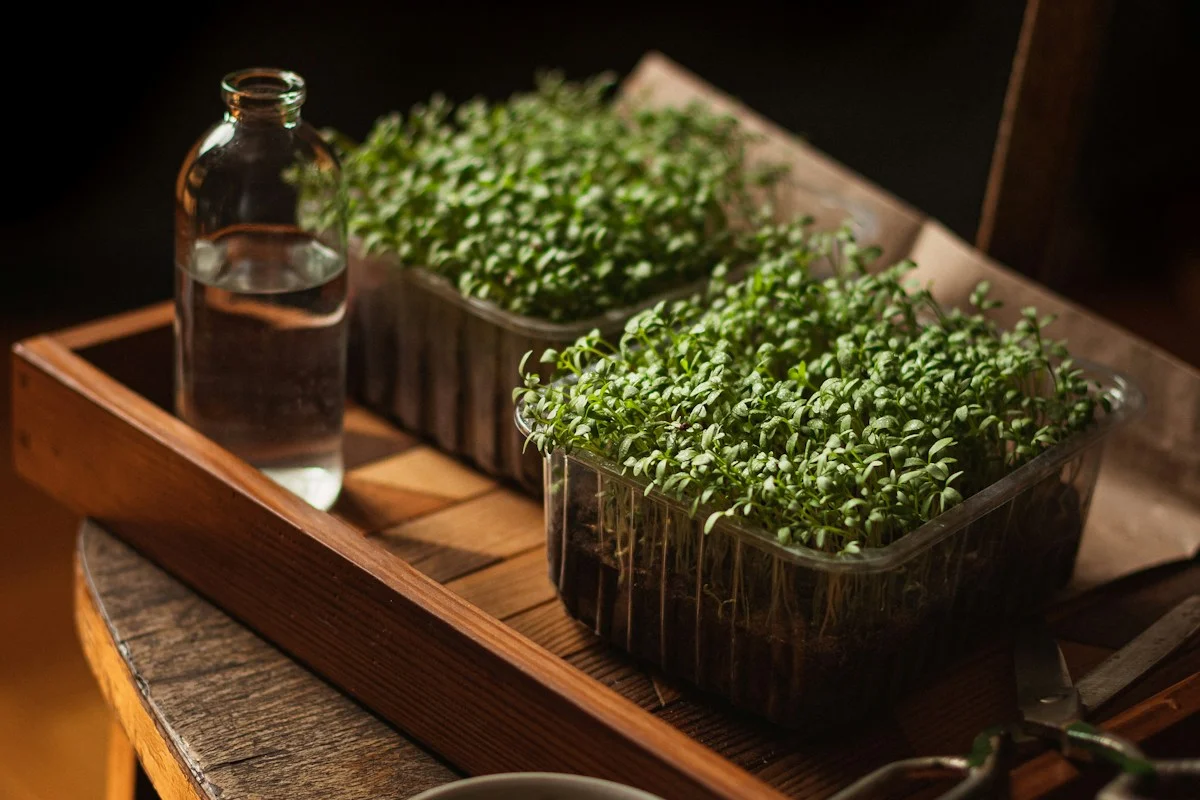
Short answer. How to grow microgreens at home: spread untreated seed thickly over 2.5 to 4 cm of damp seedling mix or coir in a shallow tray with drainage holes, cover and weight it for a few days in the dark, then move it to a bright window or under a basic LED light and water it from below. Cut with clean scissors once the first true leaves appear. Extension guides and seed companies give between them 5 to 15 days for radish, rocket, broccoli and mustard, 7 to 15 for pea shoots and sunflower, and 10 to 25 for beetroot and basil. Use fresh medium for every tray, and in a hot South African summer keep air moving round the trays to hold off mould and damping-off.
This guide covers microgreens grown in trays. For sprouts grown in a jar, see our guide to how to sprout seeds at home.
On this page
- What are microgreens, and how are they different from sprouts?
- Which microgreens are easiest for beginners?
- Where to buy microgreen seeds in South Africa
- What equipment do you need?
- How to grow microgreens at home, step by step
- Growing microgreens in South African conditions
- Do microgreens have more nutrients than mature vegetables?
- How to fix common microgreen problems
- Frequently asked questions
What are microgreens, and how are they different from sprouts?
Sprouts, microgreens and baby greens are the same plants eaten at different ages. University of Florida IFAS Extension says the three are told apart mainly by size and age (Treadwell et al., 2020).
- Sprouts are harvested earliest and eaten whole, seed and root included, before the true leaves form (UF/IFAS Broward, 2023).
- Microgreens grow in soil or another medium and are cut just above it at the seed-leaf (cotyledon) stage or as the first true leaves appear, leaving the roots behind.
- Baby greens are older again; Livingseeds calls it baby leaf once a seedling has more than four true leaves (Livingseeds).
The US Food and Drug Administration (FDA) draws its line at the true leaves, the ones that follow the first pair of seed leaves: a crop harvested with true leaves is not a sprout and “may be a microgreen” (FDA, 2019).
Which microgreens are easiest for beginners?
The fast brassicas (radish, broccoli, mustard and rocket) and the large-seeded pea and sunflower are the usual first crops. Beetroot and basil are slower. Grow one kind per tray: Penn State Extension notes that crops germinate and grow at different rates (Sánchez and Berghage, 2025).
| Seed | Soak first? | Covered in the dark | Days to harvest | Notes |
|---|---|---|---|---|
| Pea shoots | 6 hours | 3 days | 7–15 | Sweet; can be cut a second time |
| Sunflower (unhulled) | 12 hours | 3 days | 8–12 | Nutty; misting helps the hulls drop off |
| Radish | Not needed (2–4 hours optional) | 1–2 days | 5–15 | Peppery and quick |
| Broccoli | No | 2–4 days | 8–15 | Mild |
| Rocket | No | 1–2 days | 6–15 | Peppery; very small seed |
| Mustard | No | 2–3 days | 5–15 | Hot; white mustard is among the quickest |
| Beetroot | 6–8 hours | 2–3 days weighted, then about 2 more in the dark | 10–25 | Red stems; pick off any seed hulls before eating |
| Basil | No | 4–7 days | 12–25 | The slowest of the eight |
Sources: days to harvest combine Utah State University Extension (Beck, 2025), Cornell Cooperative Extension (Growing Microgreens), Mississippi State University Extension (Bachman, 2021), Johnny’s Selected Seeds (chart) and the Livingseeds Microgreens System instructions. Each range runs from the lowest to the highest figure given. Soak and dark times: Utah State, except beetroot, the radish soak and the mustard dark time (Livingseeds; no soak, as for Utah State’s other small brassicas). Pea second cut and beetroot hulls: Mississippi State. Sunflower hulls: Livingseeds.
Wheatgrass is grown in a tray in much the same way but is usually juiced rather than eaten; SanaStore.co.za has a guide to growing wheatgrass.
Where to buy microgreen seeds in South Africa
Use seed sold for sprouting or microgreens, or marked untreated. Garden seed may be coated with fungicide or pesticide, and Penn State and Cornell both advise against treated seed; Penn State notes the seed coat stays on some seedlings and gets eaten. Grocery peas, lentils and spice-rack seeds are packed for cooking, as our sprouting guide explains, so they aren’t the seed for greens you’ll eat raw.
South African suppliers we checked in November 2026:
- Seeds for Africa sells a sprouting and microgreen range it describes as “untreated, chemical free”, plus coco peat and trays (Seeds for Africa).
- Livingseeds has a Sprouts & Microgreens section (45 products when we looked), including beetroot, basil, daikon radish, mustard and sunflower seed, and trays with and without holes.
- Starke Ayres sells a microgreens range, including pea, broccoli, radish and white mustard, through supermarkets such as Shoprite and Checkers and farm stores such as Agrimark (Shoprite; Agrimark). The listings don’t say whether the seed is treated.
Whichever you buy, check the packet and skip any seed marked as treated.
What equipment do you need?
- Two trays that nest. The top one has drainage holes and holds the medium; the solid one underneath holds water for watering from below (Utah State). A third tray or a board makes the blackout lid. The seeding rates below assume a standard seedling tray of about 25 × 50 cm, but a takeaway container with holes punched in the base will do for a first try. Wash recycled containers with soap and water (Cornell).
- Growing medium. Seedling mix, coir (coco peat) or a fibre grow mat (Utah State); Penn State found mats gave cleaner harvests than potting mix. Soak compressed coir until it feels like a wrung-out sponge. Don’t use garden soil, manure or compost, which can carry bacteria (Cornell) and the fungi behind damping-off (University of Minnesota Extension).
- A spray bottle to keep the surface damp while seeds germinate (Cornell), and a 1 to 2 kg weight, such as a bag of rice.
- Light. A bright north-facing window (the southern-hemisphere version of the south-facing window American guides recommend) is enough to start. If stems stretch and the colour looks washed out, the light is too weak (Johnny’s). A basic LED grow light gives steadier results, especially through grey Western Cape winters: Cornell keeps lights about 10 cm above the seedlings, and Utah State runs them 18 hours a day on a timer. Too close, and light can dry or scorch the crop (Johnny’s).
How to grow microgreens at home, step by step
- Fill and wet the tray. Spread 2.5 to 4 cm of medium in the tray with holes (Johnny’s), level it and press it flat. It should be evenly moist, not dripping.
- Soak the large seeds. Soak pea, sunflower and beetroot for the times in the table and drain them well; small brassica seeds and basil go in dry.
- Sow thickly and evenly. Johnny’s aims for 10 to 12 small seeds, or 6 to 8 large ones, in every 2.5 cm square, pressed firmly into the surface. Start at the edges and work in (Penn State). For a 25 × 50 cm tray, Utah State uses about 10 g of rocket, 28 g of broccoli, 42 g of radish, 48 g of sunflower and 150 g of pea; Penn State uses 10 to 15 g on a slightly larger 30 × 50 cm tray (a tablespoon of brassica seed weighs 11 to 12 g). Too much seed cuts airflow and invites disease (Johnny’s).
- Mist, cover and weight. Set the lid tray directly on the misted seed and put the weight on top; Livingseeds notes that some varieties do better weighted for two or three days. Keep the tray dark for the time in the table, misting if the surface dries. Halfway through, Utah State turns the lid over so it covers the tray without pressing on the seedlings.
- Move into the light. When the dark time is up, take the lid off. The pale seedlings green up in the light.
- Water from below. Pour water into the solid tray, set the seeded tray in it, and tip out what’s left after about 30 minutes (Utah State). This keeps leaves and stems dry (Penn State). Keep the medium moist but not soggy (Minnesota); a tray that feels light needs water.
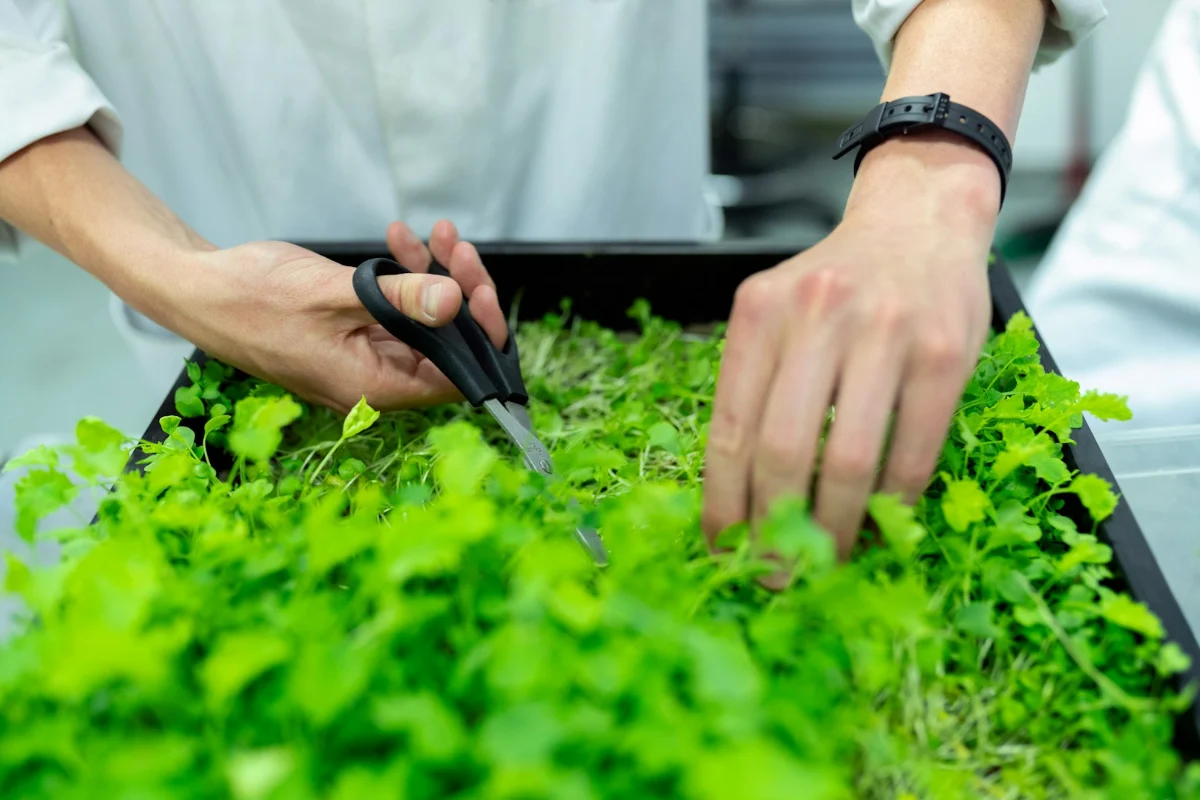
- Harvest with scissors. Cut when the first true leaves show, typically at 2.5 to 5 cm (Johnny’s). Snip just above the medium with clean scissors (Cornell), keeping roots and medium out of the bowl. Store them unwashed in a closed container in the fridge and wash them just before eating, since washing shortens shelf life (Penn State, Cornell).
- Clean the tray and start again. Most crops give one cut (Johnny’s), though pea shoots can be cut once more (Mississippi State). Compost the roots and medium and use fresh medium next time (Penn State). Scrub trays in hot, soapy water; Minnesota also suggests soaking used trays for 30 minutes in a 10% household bleach solution (one part bleach to nine of water), then rinse well. Stagger sowings for a steady supply (Livingseeds).
Growing microgreens in South African conditions
Johnny’s gives 18 to 24°C as the optimal air temperature and warns that warmer than 24°C can inhibit germination in some varieties; the University of Florida’s Broward County office suggests 16 to 21°C and about 55% humidity.
Hot, humid summers
A kitchen on the KwaZulu-Natal coast in January, or inland in a heatwave, can run well above that. Damping-off was the only disease or pest Penn State’s hydroponics class ran into, and it says warm, humid conditions favour it; and the University of Florida names mould as a common problem, worsened by heat, humidity and poor air circulation. In summer:
- Sow a little thinner (Penn State).
- Keep a small fan running near the trays; Utah State and Johnny’s both use airflow to prevent disease.
- Water from below and don’t leave trays standing in water.
- Keep trays out of hot afternoon sun behind glass, and vent covers in sunny, warm weather so heat doesn’t stop germination (Johnny’s).
- Favour the quick crops (radish, mustard, rocket).
Dry Highveld winters
Outside the Western Cape, South Africa is mainly a summer-rainfall country (gov.za), so winter on the Highveld is the dry season, and on the interior plateau nights can drop to freezing. Trays dry out faster in dry air, so check them daily and keep the blackout lid on during germination. Cold slows germination: Johnny’s suggests a soil temperature of about 24°C until seeds come up, so use the warmest room or a seedling heat mat. Minnesota links cool, wet conditions and cold water to damping-off and suggests watering seedlings at about 20 to 25°C.
Do microgreens have more nutrients than mature vegetables?
The study most often quoted is a 2012 paper in the Journal of Agricultural and Food Chemistry by researchers from the US Department of Agriculture and the University of Maryland (Xiao et al., 2012). They measured vitamin C, carotenoids, vitamin K1 and vitamin E in 25 commercially available microgreens. Levels varied widely: red cabbage had the most vitamin C, coriander the most carotenoids, garnet amaranth the most vitamin K1 and green daikon radish the most vitamin E. Compared with mature-leaf figures in the USDA National Nutrient Database, the microgreens had higher “nutritional densities”, meaning more in a given weight of leaf (the paper reports per 100 g fresh weight).
Not every crop stood out: the American Chemical Society’s release said golden pea tendrils and popcorn shoots had comparatively low levels, though still as high as some common mature vegetables (ScienceDaily, 2012). The USDA’s research magazine later wrote that “in general” the microgreens had about five times the levels of vitamins and carotenoids of their mature counterparts, without giving a range or the basis of the comparison (Bliss, 2014).
What the study does and doesn’t show:
- It compares concentration by weight. A handful of microgreens weighs far less than a serving of mature cabbage or spinach, so a higher concentration doesn’t mean more in a meal.
- It compared bought microgreens with database figures, not the same plants grown side by side. The USDA magazine notes that growing, harvesting and handling conditions may have a considerable effect on nutrient content.
- It measured four groups of vitamins and carotenoids, not minerals or fibre, and didn’t test any effect on health.
Grow microgreens for flavour, colour and a fresh harvest, and treat nutrient promises on seed packets with caution.
How to fix common microgreen problems
Is it mould or root hairs?
Fine white fuzz around the roots in the first few days is usually root hairs; our sprouting guide explains how to tell root hairs from mould. In a tray, the rinse test becomes a mist: root hairs fall flat when wet, mould stays. Mould looks more like cobwebs spreading over the seeds and surface, often from a damp, crowded patch. Throw out a tray with mould, slime or a bad smell rather than cutting round it.
Why are my microgreens tall, pale and floppy?
Usually there isn’t enough light: Cornell and Johnny’s both link stretched seedlings to weak or distant light, and the University of Florida adds that seedlings flop when conditions are too damp. Move the tray to a brighter window or bring the light to about 10 cm. If stems are already long when the lid comes off, shorten the dark period next time.
Why did only some of the seeds come up?
Patchy trays usually come from uneven sowing, seed drying out under the lid, old seed or a room that is too hot. Sow from the edges inwards, mist under the lid, and keep to the soak times; Mississippi State says priming (pre-soaking) pea and beet seed promotes even germination.
Why are seedlings collapsing at the base?
That is damping-off, caused by soil fungi and water moulds such as Pythium, Rhizoctonia and Fusarium. Minnesota describes stems turning water-soaked, then thin and wiry, and says infected seedlings rarely recover. It lists overwatering, low light and cool, wet conditions as triggers, while Penn State says warm, humid conditions favour it. Throw out the tray and clean it. Next time, use fresh medium, sow thinner, add airflow and water from below.
Frequently asked questions
How long do microgreens take to grow?
Usually one to three weeks. Radish, mustard and rocket can be ready in about a week in warm weather; beetroot and basil can take up to about 25 days.
Can you grow microgreens without soil?
Yes. Coir and fibre grow mats both work (Utah State), and Penn State found mats gave cleaner harvests than potting mix. Growing seeds in a jar with water alone is sprouting, which our sprouting guide covers.
Do microgreens need sunlight?
They need bright light after the dark period, not necessarily direct sun. A north-facing window works for the quick crops; if stems stretch and look pale, add a basic LED light about 10 cm above the tray.
Do microgreens grow back after you cut them?
Most don’t. One cut is standard (Johnny’s), though pea shoots can be cut a second time (Mississippi State).
Can I use garden seed or seed from the kitchen cupboard?
Only garden seed marked untreated; treated seed can carry fungicide or pesticide. Kitchen peas, lentils and spices are packed for cooking. For greens you’ll eat raw, buy seed sold for sprouting or microgreens, from suppliers such as Seeds for Africa, Livingseeds or Starke Ayres’ microgreens range.
Are microgreens safe to eat raw?
In one laboratory study, microgreens carried significantly less E. coli than sprouts grown from equally contaminated seed (Xiao et al., 2014), but they are not risk-free. Our article on whether sprouts are safe to eat covers the evidence. Use seed sold for eating, fresh medium (not garden soil or compost) and clean trays, and wash microgreens before eating them.
How long do microgreens last in the fridge?
Johnny’s gives 5 to 10 days under proper storage: unwashed, in a closed container in the fridge. Throw out any that turn slimy.
Sources
All opened and checked on 3 Nov 2026 unless noted.
- US Food and Drug Administration. Standards for Produce Safety: Determining Coverage under Subpart M of the Produce Safety Rule, December 2019. https://fda.gov/media/133546/download
- Treadwell D, Hochmuth R, Landrum L, Laughlin W. Microgreens: A New Specialty Crop, HS1164, UF/IFAS Extension, rev. September 2020. https://journals.flvc.org/edis/article/view/123356 (only the introduction and definitions could be read; used for the definition only)
- Bravo L. “Sustainable Gardening: How to Grow Microgreens at Home,” UF/IFAS Extension Broward County, 6 April 2023 (updated 10 May 2023). https://blogs.ifas.ufl.edu/browardco/2023/04/06/sustainable-gardening-how-to-grow-microgreens-at-home/
- Sánchez E, Berghage R. “Growing Microgreens,” Penn State Extension, updated 16 December 2025. https://extension.psu.edu/growing-microgreens
- Beck S. “Grow Your Own Microgreens,” Utah State University Extension, 20 February 2025, updated January 2026. https://extension.usu.edu/yardandgarden/research/grow-your-own-microgreens
- Cornell Cooperative Extension, Orange County. “Growing Microgreens” (adapted from Amy Dabbs, Clemson Extension), undated. https://dlc.cce.cornell.edu/pluginfile.php/376604/mod_resource/content/1/Growing%20Microgreens%20-%20CCEOC.pdf
- Bachman GR. Microgreen Varieties for the Mississippi Gardener, Publication 2884, Mississippi State University Extension, 2021 (copy hosted by Cornell). https://dlc.cce.cornell.edu/pluginfile.php/376593/mod_resource/content/1/Microgreen%20Varieties%20-%20Mississippi%20State%20Extension.pdf
- Johnny’s Selected Seeds. Microgreens Production, rev. 16 January 2026. https://www.johnnyseeds.com/on/demandware.static/-/Library-Sites-JSSSharedLibrary/default/dw708a334c/assets/information/8079-micro-greens-production.pdf
- Johnny’s Selected Seeds. Microgreens comparison chart (growth groups and growing notes). https://johnnyseeds.com/on/demandware.static/-/Library-Sites-JSSSharedLibrary/default/dw930150f1/assets/information/microgreens-comparison-chart-pdf.pdf
- Livingseeds. Sprouts & Microgreens category and growing notes. https://www.livingseeds.co.za/sprout-and-microgreen-seed
- Livingseeds. Striped Sunflower Seeds, Sprout & Microgreen Seed. https://livingseeds.co.za/unhulled-sunflower-seeds.html
- Livingseeds Microgreens System, product listing and growing instructions, Faithful to Nature. https://www.faithful-to-nature.co.za/livingseeds-microgreens-system
- Seeds for Africa. “Sprouting & Microgreen Seeds.” https://seedsforafrica.co.za/pages/sprouting-microgreen-seeds
- Starke Ayres Microgreens range, retailer listings: Shoprite (Peas Greenfeast), https://www.shoprite.co.za/All-Departments/Outdoor/Garden/Planting-Seeds/Starke-Ayres-Microgreens-Peas-Greenfeast-Seeds/p/10815471EA; Agrimark (Broccoli), https://www.agrimark.co.za/product/starke-ayres-microgreens-broccoli; Checkers (White Mustard), https://www.checkers.co.za/All-Departments/Outdoor/Garden/Planting-Seeds/Starke-Ayres-Microgreens-White-Mustard-Seeds/p/10815464EA; Agrimark (Radish Sparkler), https://agrimark.co.za/product/starke-ayres-microgreens-radish-sparkler. None states whether the seed is treated.
- Grabowski M. “How to prevent seedling damping off,” University of Minnesota Extension, reviewed 2024. https://extension.umn.edu/solve-problem/how-prevent-seedling-damping
- Xiao Z, Lester GE, Luo Y, Wang Q. “Assessment of vitamin and carotenoid concentrations of emerging food products: edible microgreens.” Journal of Agricultural and Food Chemistry 2012; 60(31): 7644–51. https://pubmed.ncbi.nlm.nih.gov/22812633/ (abstract via PubMed and Europe PMC; the full text on pubs.acs.org was not read)
- American Chemical Society. “Many trendy ‘microgreens’ are more nutritious than their mature counterparts,” via ScienceDaily, 29 August 2012. https://www.sciencedaily.com/releases/2012/08/120829131634.htm
- Bliss RM. “Specialty Greens Pack a Nutritional Punch.” Agricultural Research (USDA Agricultural Research Service), January 2014. https://agresearchmag.ars.usda.gov/AR/archive/2014/Jan/greens0114.pdf
- Xiao Z, Nou X, Luo Y, Wang Q. “Comparison of the growth of Escherichia coli O157:H7 and O104:H4 during sprouting and microgreen production from contaminated radish seeds.” Food Microbiology 2014; 44: 60–3. https://pubmed.ncbi.nlm.nih.gov/25084646/
- Xiao Z. Nutrition, Sensory, Quality and Safety Evaluation of a New Specialty Produce: Microgreens, thesis, University of Maryland, 2013. https://drum.lib.umd.edu/handle/1903/14900 (record page; used only to confirm the University of Maryland affiliation)
- South African Government. “Geography and climate.” https://www.gov.za/about-sa/geography-and-climate