

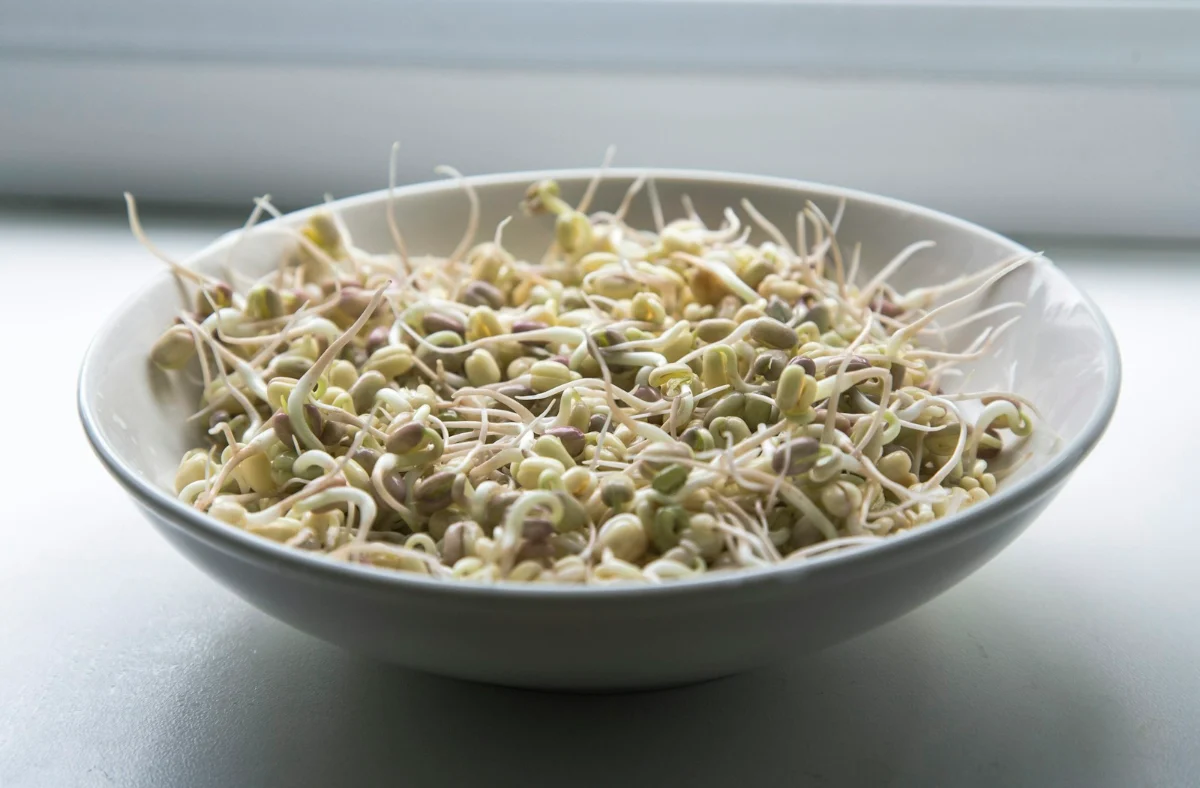
Short answer. The basic method for how to sprout seeds at home is to soak them in water (from half an hour for hulled sunflower seeds to about 12 hours for wheat berries), drain them well, then rinse and drain them twice a day in a jar or tray kept out of direct sun at around room temperature. Lentils, chickpeas and wheat are ready in two or three days; small leafy seeds such as alfalfa and broccoli take three to seven. Buy seed sold for sprouting, keep finished sprouts in the fridge and eat them within a few days. Raw sprouts carry a known risk of bacteria from the seed, so pregnant women, young children, older people and anyone with weakened immunity should eat them cooked.
On this page
- What is sprouting?
- What equipment do you need to sprout seeds?
- How to sprout seeds in a jar, step by step
- Soak and sprout times for common seeds
- How often should you rinse sprouts, and how warm should they be?
- How much do seeds yield?
- How do you store sprouts?
- What should you not sprout or eat raw?
- How to buy seed for sprouting
- Are sprouts safe to eat raw?
- How do you fix common sprouting problems?
- Frequently asked questions
What is sprouting?
Sprouting is germination stopped early. A dry seed takes up water, wakes up and pushes out a small root (the “tail”) and, in leafy types, a pair of seed leaves. You eat the whole thing, seed and shoot, days before it would need soil. It is an easy way to eat more fresh greens and legumes year round, grown on a kitchen counter for the price of a packet of seed.
Germination does change a seed’s nutrients and plant compounds, but by how much depends on the seed: a 2019 review in the journal Nutrients names the variety, the conditions the parent plant grew in and the germination conditions as the main factors (Benincasa et al., 2019). Sprout for freshness, flavour and variety, and treat precise nutrient promises on seed packets with caution.
What equipment do you need to sprout seeds?
You need something that holds damp seed, drains completely and lets air in. Three kinds of sprouter do that.
Glass jar with a mesh lid
A wide-mouth glass jar of about a litre with a mesh lid is the cheapest way to start. After each rinse you stand it upside down at an angle in a bowl or dish rack so water runs out and air gets in. Jars suit beans, lentils, chickpeas and grain. Their weak point is small leafy seeds, which can pack into a damp mat that drains badly. Muslin and an elastic band will do in place of a mesh lid, though muslin drains more slowly.
Tray sprouters
Tray sprouters are stacks of shallow trays with drainage slots. Water poured into the top tray runs down through each tier and collects at the bottom. The seed sits in a thin layer with air all round it, which makes trays the better choice for alfalfa, broccoli, radish and fenugreek, and lets you run two or three varieties at once. There are more parts to wash than with a jar.
Automatic sprouters
Automatic sprouters are mains-powered units that spray or flood the seed with water on a timer and drain it away, so the rinsing is done for you. They suit people who sprout every week or are out all day. They cost more, and the reservoir and spray parts need cleaning between batches.
Whichever type you choose, wash it in hot, soapy water between batches and let it dry fully.
How to sprout seeds in a jar, step by step
- Measure the seed. For a 1-litre jar, one to two tablespoons of small seed (alfalfa, broccoli, radish, fenugreek) or about half a cup (125 ml) of beans, lentils or grain is plenty. Small seeds expand far more than you would expect.
- Rinse and sort. Rinse the dry seed and pick out stones, broken seeds and anything discoloured.
- Soak. Cover the seed with two to three times its volume of room-temperature water (Sproutpeople) and leave it for the time given in the table below.
- Drain thoroughly. Pour off the soak water and shake the jar until no more drips out. Sproutpeople names poor draining as the most common reason home sprouts fail (Sproutpeople help page).
- Rinse and drain twice a day. Morning and evening, fill the jar with cool water, swirl, drain and set it back at an angle. In hot weather, add a midday rinse (see below).
- Keep it out of the sun. A shaded spot at around room temperature is right. Leafy sprouts can sit in indirect daylight for their last day to green up.
- Harvest. When the tails reach the length in the table, give the sprouts a final rinse. Loose hulls float to the top of the water, so you can skim them off (NC State Extension).
- Dry and chill. Drain well, let the sprouts sit until they are dry to the touch, then refrigerate them in a sealed container.
Soak and sprout times for common seeds
This sprouting chart draws on seed companies that sell sprouting seed. Figures vary between suppliers and with kitchen temperature, so treat them as a starting point and go by tail length.
| Seed | Soak (hours) | Days to harvest | Tail length at harvest | Notes |
|---|---|---|---|---|
| Alfalfa | 4–8 | 3–5 | 4–5 cm | Leafy; green on the last day |
| Broccoli | 2–3 | 5–7 | 4–5 cm | A mild sulphur smell is normal |
| Radish | 4–6 | 2–5 | 1–4 cm | Peppery |
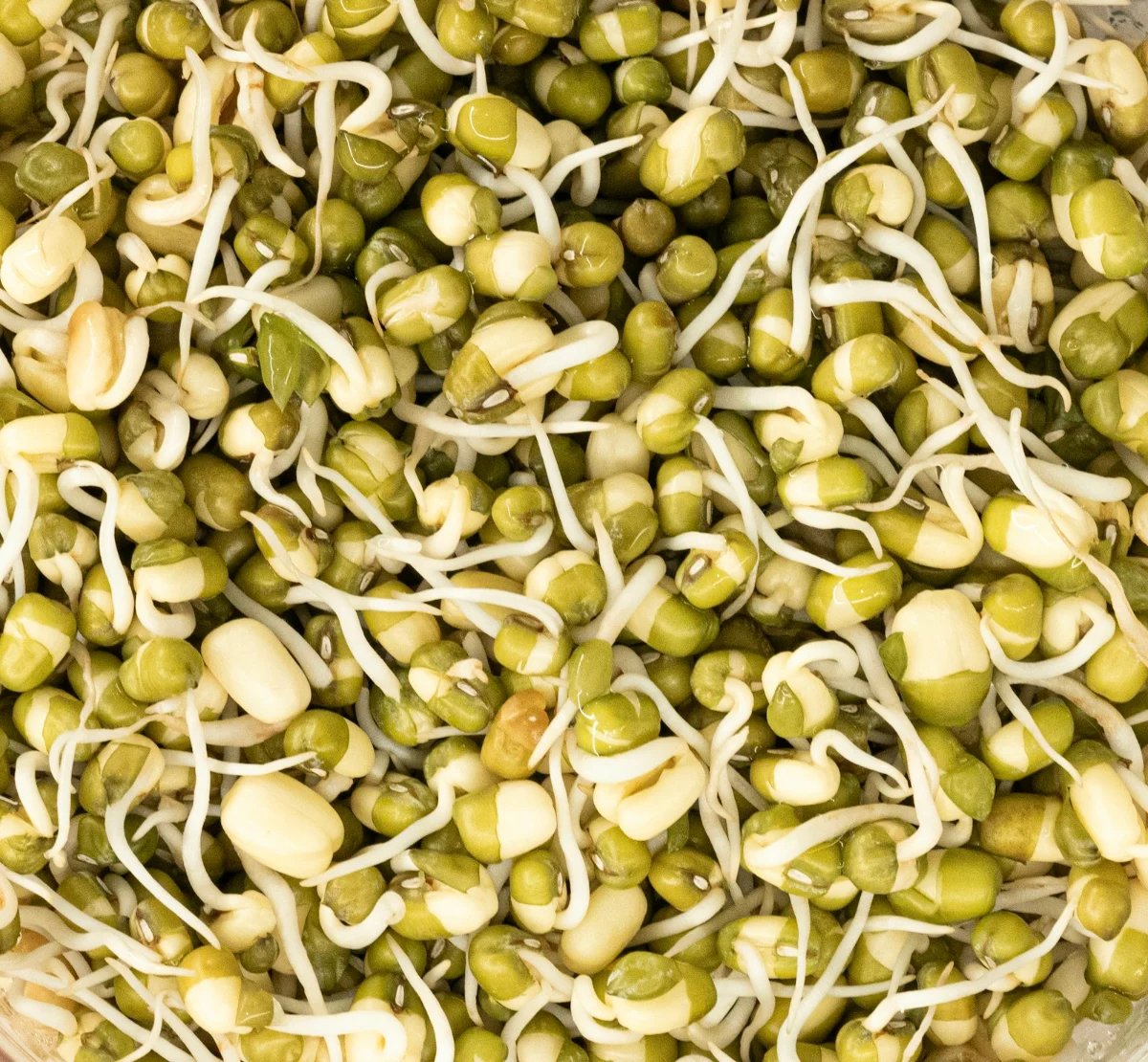
| Mung bean | 6–8 | 4–5 | 2.5–5 cm | Longer “bean sprouts” take longer (see below) |
| Lentil (whole) | 4–8 | 2–3 | 1–2 cm | Use whole lentils, not split |
| Chickpea | 6–8 | 2–3 | 1–2 cm | Often cooked, or used for hummus |
| Wheat berries | 6–12 | 2–3 | 6–13 mm | Grow on for wheatgrass |
| Sunflower (hulled) | ½–2 | 1–2 | Barely visible | Eaten as soaked, just-woken seeds |
| Fenugreek | 6–12 | 3–5 | 4–5 cm | Rich flavour |
Sources: soak times from the Mumm’s Sprouting Seeds guide (Mumm’s gives its chickpea and fenugreek figures for seed mixes that contain them); wheat and sunflower soak times from Sproutpeople (wheat, sunflower). Days to harvest and tail lengths from the Johnny’s Selected Seeds sprouting chart, converted from inches; sunflower from Sproutpeople.
A few notes on the table:
- How to sprout mung beans for stir-fries. The short tails in the table are for eating fresh. For the long, crisp bean sprouts used in Asian cooking, NC State Extension’s bean sprout leaflet gives three to seven days at 21–27°C in the dark, harvesting at about 6–10 cm, and notes that sprouts left to grow past 10 cm may turn bitter (NC State Extension).
- Lentils and chickpeas. Johnny’s suggests harvesting lentils as soon as the small white root shows if you plan to cook them, and giving them another day or two if you want to eat them fresh.
- Wheat. Sproutpeople recommends stopping when the roots are about 6 mm long. Left to grow on, wheat berries become wheatgrass; SanaStore.co.za is publishing a guide to growing wheatgrass at home. Sprouted wheat can also be dried at a low temperature, for example on the trays of an Ezidri Ultra FD1000 dehydrator, and milled into flour; a SanaStore guide to that process is on the way.
- Sunflower. Hulled sunflower seeds are eaten soon after soaking, when the germ has only just begun to swell.
How often should you rinse sprouts, and how warm should they be?
Rinse and drain at least twice a day: Johnny’s, Mumm’s and NC State all give twice daily as the minimum, and Sproutpeople suggests every 8 to 12 hours (Sproutpeople). Use cool water; Sproutpeople advises about 16–21°C unless your seed supplier says otherwise (Sproutpeople help page).
For the sprouter itself, NC State Extension gives 21–27°C in a dark place (NC State Extension). Warmth speeds sprouting, so the same seed can be ready a day or two sooner in summer.
Sprouting in a South African summer (November to February)
A kitchen on a Highveld summer afternoon or during a Cape heatwave can climb above that range, and heat cuts both ways: sprouts grow faster, and so do moulds and spoilage bacteria. Sproutpeople notes that fungus is mainly a problem in hot, humid conditions and suggests moving the sprouter or running a fan. For the hot months:
- Add a midday rinse, using the coolest water from the tap.
- Move the sprouter to the coolest room, away from windows, the stove and the kettle, somewhere air moves freely (never a closed cupboard).
- Sprout smaller batches and check them daily; they may be ready a day early.
Do sprouts need light?
Not while they are growing. NC State recommends a dark place and Sproutpeople says to keep the sprouter out of direct sunlight. Leafy sprouts such as alfalfa and broccoli can spend their last day in indirect light; Mumm’s suggests harvesting just as they begin to green.
How much do seeds yield?
Small seeds swell the most. Johnny’s gives about one and a half cups (roughly 350 ml) of alfalfa sprouts from a tablespoon of seed, and Mumm’s three to four cups, so expect a range. Larger seeds swell less: Johnny’s gives about a cup of sprouts from a quarter cup of mung beans (roughly fourfold by volume) and one and a half to two cups from half a cup of wheat berries.
For a steady supply, NC State Extension suggests starting a fresh batch every three days, so one jar is ready while the next grows.
How do you store sprouts?
Store sprouts dry and cold. After the final rinse, drain them well and let them sit until they are dry to the touch. Keep them in a sealed container in the fridge at 4°C or below, in line with the 40°F (about 4°C) the US FDA gives for perishable produce and University of Maine Extension gives for sprouts (FDA; UMaine Extension).
Eat them within a few days. Johnny’s says sprouts keep for up to a week, but Health Canada advises eating sprouts that aren’t prepackaged within a few days, and throwing out any that have lost their crispness, look dark or smell musty (Health Canada). Wheat sprouts keep growing slowly in the fridge, so use them first.
What should you not sprout or eat raw?
Raw red kidney beans
Red kidney beans contain a lectin called phytohaemagglutinin. An archived edition of the US FDA’s Bad Bug Book states that as few as four or five raw beans can trigger symptoms, usually within one to three hours, and that undercooked beans may be more toxic than raw ones (FDA Bad Bug Book, archived); Health Canada gives the same one-to-three-hour onset (Health Canada). Australia’s Food Safety Information Council lists severe stomach ache, vomiting and diarrhoea, and gives the same four-or-five-bean figure and advises soaking dried kidney beans for at least five hours, then boiling them briskly in fresh water for at least ten minutes; a slow cooker may not destroy the toxin (Food Safety Information Council). Sprouting is no substitute for that boil, so leave kidney beans out of raw sprouting mixes.
Treated garden seed
Seed packed for planting in the garden may be coated with fungicide or pesticide. NC State Extension warns that treated seed is not edible and often shows a pink or green dust on the seed coat (NC State Extension).
How to buy seed for sprouting
Buy seed sold for sprouting, which is packed as food rather than for planting; health shops are a good place to look. Whole dried mung beans, lentils, chickpeas and wheat berries from the grocery shelf will often sprout too, but they are packed for cooking, so cook them unless the pack says otherwise. Split lentils, pearled barley and roasted seeds are best kept for cooking; they are unlikely to sprout.
Keep dry seed in a cool, dark, dry cupboard; Sproutpeople gives about one year for hulled sunflower and two for wheat, and notes that germination drops as seed ages, so buy fresh if old seed lets you down (Sproutpeople help page).
Are sprouts safe to eat raw?
Sprouts carry a particular food-safety risk because the warm, wet conditions that make seeds sprout also suit bacteria such as Salmonella and E. coli, and the seed itself is usually the source, so a few bacteria on the seed can multiply to high levels even in a clean home kitchen (FoodSafety.gov, archived). For that reason the US FDA and the Food Safety Authority of Ireland advise children, older adults, pregnant women and people with weakened immune systems to avoid raw or lightly cooked sprouts and to eat them cooked (FDA; FSAI). If you have a health condition, ask your doctor before adding raw sprouts to your diet. We’ll cover sprout safety in more detail in a dedicated article.
How do you fix common sprouting problems?
Is it mould or root hairs?
Most white fuzz on sprouts is root hairs: fine, feathery hairs on the tail, most visible just before a rinse when the sprouts are driest. Sproutpeople’s test is to rinse: root hairs fall back against the root and seem to vanish until the sprouts dry again (Sproutpeople help page). Mould doesn’t rinse away. It looks more like cobwebs around clusters of seeds, often around broken or empty ones (Lowimpact.org), and Sproutpeople links it mainly to hot, humid conditions. Discard any batch with mould, sliminess or dark patches.
Why do my sprouts smell sour?
A sour or musty smell usually means the sprouts are staying too wet or too warm: water pooling in the jar, seed packed too thickly, or a hot kitchen. Drain more thoroughly, use less seed and rinse more often. Broccoli and radish sprouts give off a mild sulphur smell, which Sproutpeople describes as normal. Sprouts that still smell bad after rinsing belong in the compost.
Why didn’t my seeds sprout?
The usual causes are old, split or heat-treated seed, too short a soak, or sprouts drying out between rinses. A seed still floating after the soak is sometimes dead, and “hard seeds” that refuse water can be re-soaked at about 32–38°C, Sproutpeople suggests. NC State Extension notes that chlorinated tap water can cause poor sprouting, so if fresh seed fails, try filtered water.
Frequently asked questions
How long does it take to sprout seeds?
One to seven days. Hulled sunflower takes a day or two, lentils, chickpeas and wheat two or three, and alfalfa and broccoli three to seven. Warm kitchens finish sooner.
Do you have to soak seeds before sprouting?
Yes. The soak gives the seed the water it needs to start growing: two to eight hours for most small seeds, roughly four to twelve for lentils, beans and grain. After that, rinse and drain.
Is the white fuzz on my sprouts mould?
Usually not. Fine white hairs along the root that vanish when you rinse are root hairs. Cobweb-like growth that stays after rinsing, or any sliminess or bad smell, means the batch should be discarded.
Are homegrown sprouts safer than shop-bought ones?
Not necessarily. Bacteria usually come from the seed, and they can multiply during sprouting even in a clean kitchen. Pregnant women, young children, older people and anyone with weakened immunity should eat sprouts cooked, whoever grew them.
Can I sprout lentils and mung beans from the supermarket?
Usually, if they are whole and not split, roasted or very old. Seed sold for sprouting is the better choice for eating raw; grocery beans and lentils are packed for cooking, so cook them.
How long do sprouts last in the fridge?
A few days at their best. Dry them well, keep them sealed at 4°C or below, and throw them out if they turn slimy, dark or musty.
Can you sprout kidney beans?
Not for eating raw. Raw and undercooked red kidney beans contain a toxin that can cause severe vomiting, and they need a proper soak and at least ten minutes of hard boiling to be safe.
Equipment from EcoHub
- Ezidri Ultra FD1000 5-tray food dehydrator: R6,295 incl VAT. Five trays (expandable), digital control from 30 to 70°C; useful for drying sprouted grain before milling.
Prices correct at November 2026, incl VAT.
Sources
All opened and checked on 2 Nov 2026.
- Benincasa P, Falcinelli B, Lutts S, Stagnari F, Galieni A. “Sprouted Grains: A Comprehensive Review.” Nutrients 2019; 11(2): 421. https://www.mdpi.com/2072-6643/11/2/421
- Bass L, Sanders D. “Bean Sprouts and Other Vegetable Seed Sprouts.” Horticulture Information Leaflet, NC State Extension. https://content.ces.ncsu.edu/bean-sprouts-and-other-vegetable-seed-sprouts
- Johnny’s Selected Seeds. “Sprouting Seeds” growing instructions and chart. https://www.johnnyseeds.com/on/demandware.static/-/Library-Sites-JSSSharedLibrary/default/dw3bca4831/assets/information/8969-sprouts-growing-instructions.pdf
- Mumm’s Sprouting Seeds. Sprouting guide (May 2021). https://cdn.shopify.com/s/files/1/0249/1474/files/Mumms_Guide_May2021.pdf
- Sproutpeople. Sprouting help (root hairs, draining, temperature, hard seeds). https://sproutpeople.org/sprouts/help
- Sproutpeople. Wheat sprouts. https://sproutpeople.org/wheat-sprouts
- Sproutpeople. Sunflower sprouts (hulled). https://sproutpeople.org/sunflower-sprouts/
- Lowimpact.org (Dave Darby). “How to tell the difference between feathery roots and mould.” https://www.lowimpact.org/posts/infoarticle/tell-difference-feathery-roots-mould/
- US Food and Drug Administration. “Selecting and Serving Produce Safely.” https://www.fda.gov/food/buy-store-serve-safe-food/selecting-and-serving-produce-safely
- US FDA. Bad Bug Book, Phytohaemagglutinin (kidney bean lectin) chapter, archived copy. https://webarchive.library.unt.edu/eot2008/20090512012540/http:/vm.cfsan.fda.gov/~mow/chap43.html
- FoodSafety.gov (US government). “Sprouts: What You Should Know,” archived copy. https://webarchive.library.unt.edu/web/20120915084119/http://www.foodsafety.gov/keep/types/fruits/sprouts.html
- Food Safety Authority of Ireland. “Bean Sprouts.” https://www.fsai.ie/Business-Advice/Running-a-Food-Business/Food-Safety-and-Hygiene/Microbiological-Hazards/Bean-Sprouts
- Health Canada. “Food safety tips for sprouts.” https://www.canada.ca/en/health-canada/services/food-safety-fruits-vegetables/sprouts.html
- University of Maine Cooperative Extension. Sprout safety. https://extension.umaine.edu/food-health/?p=15942
- Food Safety Information Council (Australia). “Kidney beans.” https://www.foodsafety.asn.au/kidney-beans/
- EcoHub. Ezidri Ultra FD1000 5-tray product page (price and specification). https://www.ecohub.co.za/shop/dehydrators/ezidri-ultra-dehydrator/
- Health Canada. “Lectins in Dry Legumes” (onset of symptoms, soaking and boiling advice). https://www.canada.ca/en/health-canada/services/food-nutrition/food-safety/chemical-contaminants/natural-toxins/lectins-legumes.html